
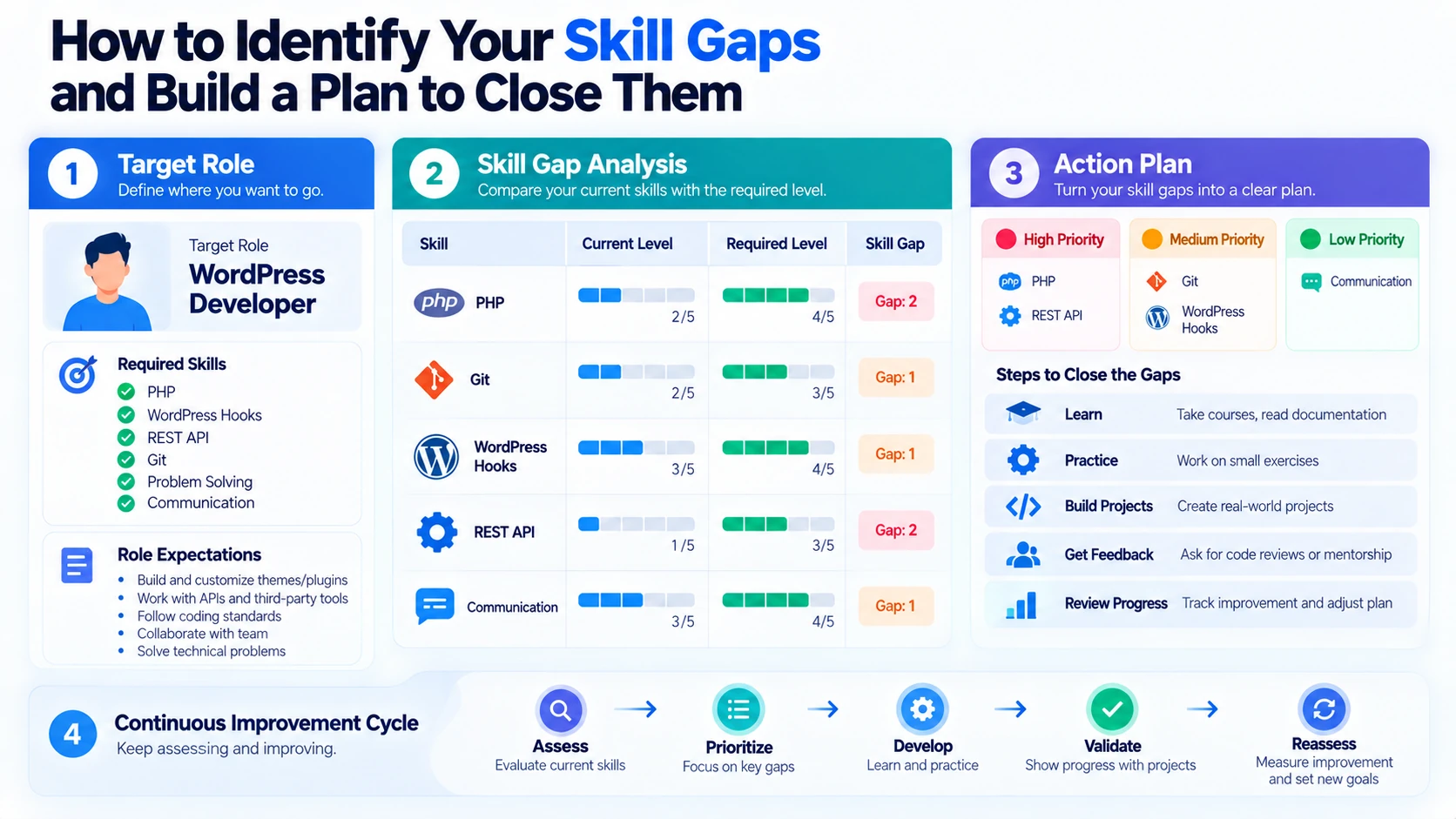
A skill gap analysis helps you understand the difference between the skills you have now and the skills you need for your target role. Without this comparison, it is easy to waste time learning random tools, taking unrelated courses, or focusing on skills that do not actually move your career forward.
A practical skill gap analysis follows a simple process:
Target Role → Required Skills → Current Skills → Gap → Priority → Action Plan
This guide will show you how to identify your skill gaps, score them realistically, prioritize the gaps that matter most, and build a practical plan to close them.
What Is a Skill Gap Analysis?
A skill gap analysis compares your current abilities with the level required for a target role, promotion, career change, or professional goal.
- Current PHP level: 2/5
- Required PHP level: 4/5
- Skill gap: 2 levels
The point is not just to list what you do not know. The real goal is to identify which skills matter, how large the gap is, how important the skill is, what evidence supports your assessment, and what action should come next.
Indeed’s skill gap guide also frames the process around comparing current abilities with the skills required for future responsibilities or roles.
A good skill gap analysis turns vague career uncertainty into a structured development plan.
Why Skill Gap Analysis Matters for Career Growth
Without a clear analysis, professional development can become random. You may complete courses without applying the skills, learn tools that are not relevant to your target role, ignore important soft skills, underestimate major weaknesses, or spend too much time on low-impact gaps.
A skill gap analysis helps you focus on what matters most. It can support promotions, career changes, technical specialization, leadership development, job readiness, better learning decisions, and more focused career planning.
It also works naturally with your career development plan, because once you know the gaps, you can turn them into specific actions and milestones.
Skill Gap Analysis vs Skills Assessment
| Skills Assessment | Skill Gap Analysis |
| Measures what you can do now | Compares current skills with required skills |
| Focuses on present ability | Focuses on what is missing |
| Can stand alone | Needs a target role or career goal |
| Example: PHP = 2/5 | Required PHP = 4/5, gap = 2 |
| Describes current capability | Guides development priorities |
A skills assessment tells you where you are. A skill gap analysis tells you what you need to close.
Step 1: Define Your Target Role or Career Goal
You cannot identify a meaningful gap without a target. First decide what you are aiming for.
- a promotion
- a new role
- a specialist position
- a career switch
- a freelance path
- leadership responsibility
- a technical upgrade
Ask yourself:
- What role do I want next?
- What responsibilities does it include?
- What outcomes are expected?
- What skills are essential?
- What skills are useful but optional?
If you are still unclear, start with your broader career goals first. The clearer the target, the more useful the gap analysis becomes.
MBA.com’s personal skills gap analysis guide recommends starting with a clear career goal, reviewing role requirements, and using feedback to identify missing skills.
Step 2: Identify the Skills Required for the Target Role
Now list the skills the target role actually requires. Do not rely on one source. Use several forms of evidence:
- job descriptions
- role profiles
- manager feedback
- project requirements
- official documentation
- interview feedback
- professional communities
- real work expectations
Technical Skills
- PHP
- JavaScript
- SQL
- Git
- REST APIs
- automation
- WordPress development
- testing tools
Soft Skills
- communication
- prioritization
- collaboration
- leadership
- stakeholder management
- problem-solving
- decision-making
Domain Knowledge
- ecommerce
- fintech
- healthcare
- SaaS
- education
- logistics
A strong career plan looks at all three categories. Technical skills alone are often not enough for higher-level roles.
Step 3: Assess Your Current Skill Level Honestly
Now rate your current capability. A simple 1–5 scale can help.
| Score | Meaning |
| 1 | Limited awareness |
| 2 | Basic knowledge |
| 3 | Can handle common tasks independently |
| 4 | Strong practical capability |
| 5 | Advanced / can guide others |
This scale is a self-assessment aid, not an objective certification.
Use evidence where possible, including recent projects, code reviews, manager feedback, peer feedback, test assignments, interview results, portfolio work, and practical output.
Do not rate yourself only by confidence. Confidence and competence are not always the same.
Step 4: Calculate the Skill Gap
Once you have both current and required levels, compare them.
Required Level – Current Level = Skill Gap
This is a simple planning method, not a standardized professional scoring system.
Example:
- Required PHP level = 4
- Current PHP level = 2
- Gap = 2
| Skill | Current | Required | Gap |
| PHP | 2 | 4 | 2 |
| Git | 2 | 3 | 1 |
| WordPress Hooks | 3 | 4 | 1 |
| REST API | 1 | 3 | 2 |
The size of the gap is useful, but it should not be the only factor. A large gap in a low-priority skill may matter less than a small gap in a critical skill.
Step 5: Prioritize Your Skill Gaps
A strong skill gap analysis does not treat every gap equally. Use two factors:
Gap Size + Career Importance
- High importance + large gap = High priority
- High importance + small gap = Medium/High priority
- Medium importance + large gap = Medium priority
- Low importance + large gap = Lower priority
- Low importance + small gap = Low priority
| Skill | Gap | Role Importance | Priority |
| PHP | 2 | High | High |
| Git | 1 | High | High |
| REST API | 2 | Medium | Medium |
| Design Tools | 3 | Low | Low |
MindTools’ skills gap analysis guide also emphasizes prioritizing important gaps and turning them into a practical development plan.
This prevents you from spending time on the wrong skills.
Step 6: Validate Your Analysis With Evidence
Self-assessment can be useful, but it can also be biased. Validate your conclusions with evidence.
- manager feedback
- peer feedback
- code review comments
- practical assessments
- portfolio results
- failed interview questions
- performance reviews
- job-description requirements
For example, you may believe your communication is strong. But if you repeatedly receive feedback that your project updates are unclear, that is useful evidence of a gap.
Likewise, you may feel weak in a technical area but still consistently deliver strong work. Evidence helps correct both overconfidence and underconfidence.
Step 7: Turn High-Priority Gaps Into Action Steps
Once the priority gaps are clear, turn them into specific actions.
Example: PHP = 2/5, required = 4/5.
Weak action: Learn PHP.
Better actions:
- revise PHP fundamentals
- practice arrays, functions, and OOP
- build one small PHP project
- use PHP inside a WordPress plugin
- get code reviewed
- fix repeated mistakes
- document what improved
If your goal is plugin development, a practical WordPress plugin development project can help you apply PHP in a real context.
If hooks are a major gap, studying and practicing WordPress hooks gives you a direct way to build that capability.
Action steps should be visible and measurable.
Step 8: Choose the Right Development Method
| Gap Type | Useful Development Method |
| Knowledge gap | Course, documentation, reading |
| Practical gap | Real project, hands-on task |
| Feedback gap | Mentor, peer review, code review |
| Communication gap | Presentations, stakeholder updates |
| Leadership gap | Project ownership, mentoring |
| Tool gap | Repeated hands-on practice |
Do not automatically choose a course for every problem. A course can help with knowledge, but practical capability usually requires doing real work.
Step 9: Build a 30/60/90-Day Skill Gap Plan
First 30 Days
- confirm target role
- identify top skill gaps
- validate ratings
- choose development methods
- choose learning resources
- define one practical project
Days 31–60
- work on priority skills
- build real output
- ask for feedback
- document recurring mistakes
- adjust your learning plan
Days 61–90
- complete the project
- reassess current skill level
- document what improved
- update portfolio or CV
- identify the next priority gap
A 90-day plan should create meaningful progress, not solve every gap.
Step 10: Measure Whether the Gap Is Actually Closing
Progress should be measured through capability, not just activity.
- fewer errors
- better project quality
- faster task completion
- more independent work
- stronger interview answers
- better manager feedback
- more project ownership
- successful portfolio output
- improved confidence supported by evidence
Weak proof: Watched 20 tutorials.
Stronger proof: Built and documented a working plugin using the skill.
Measure capability, not content consumption.
Personal Skill Gap Analysis Example
Target Role
Mid-Level WordPress Developer
Required Skills
- PHP
- Git
- WordPress hooks
- plugin architecture
- REST API
- debugging
- communication
Gap Matrix
| Skill | Current | Required | Gap | Priority |
| PHP | 2 | 4 | 2 | High |
| Git | 2 | 3 | 1 | High |
| WordPress Hooks | 3 | 4 | 1 | Medium |
| Plugin Architecture | 2 | 4 | 2 | High |
| REST API | 1 | 3 | 2 | Medium |
| Communication | 3 | 4 | 1 | Medium |
Priority Order
- PHP
- Plugin Architecture
- Git
- WordPress Hooks
- REST API
- Communication
The order is not based only on gap size. PHP, plugin architecture, and Git are high priority because they are central to the target role. A structured WordPress developer roadmap can help you understand how these skills fit together.
Skill Gap Analysis for a Career Change
Career changers often make one major mistake: they assume they are starting from zero. That is usually not true.
For example, a QA professional moving into development may already have:
- debugging skills
- product understanding
- API awareness
- attention to detail
- problem-solving
- technical communication
The missing skills may include:
- programming fundamentals
- Git
- framework knowledge
- application architecture
- portfolio projects
A good skill gap analysis separates transferable skills from true missing skills. This makes the transition more realistic and prevents unnecessary relearning.
Common Skill Gap Analysis Mistakes
No Clear Target Role: Without a target, the analysis becomes a random list of weaknesses.
Rating Yourself Only by Confidence: Confidence is not enough. Use evidence.
Treating Every Gap as Equally Important: Prioritize based on role importance.
Ignoring Soft Skills: Communication, ownership, and decision-making can matter as much as technical depth.
Copying Job Descriptions Blindly: Job descriptions can help, but they may include idealized or overly broad requirements. Use multiple sources.
Choosing Too Many Skills: Too many priorities create weak focus. Start with the few that matter most.
Having No Evidence: A rating without evidence is only an opinion.
Having No Action Plan: Identifying gaps is useful only if it changes what you do next.
Never Reassessing: Skills improve and requirements change. Review the analysis regularly.
Confusing Course Completion With Competence: Finishing a course does not automatically mean you can perform the skill in a real environment.
Personal Skill Gap Analysis Template
Target Role: ________________________
Target Date: ________________________
Required Skills: ________________________
Current Skill Level: ________________________
Required Skill Level: ________________________
Gap: ________________________
Role Importance: ________________________
Priority: ________________________
Action Steps: ________________________
Development Method: ________________________
Evidence of Progress: ________________________
Review Date: ________________________
Keep the template simple enough to review regularly.
How Skill Gap Analysis Fits Into Career Planning
A skill gap analysis is one part of a larger career system.
Career Goal → Skill Gap Analysis → Development Plan → Progress Review
Your career goals define the outcome. Your skill gap analysis identifies what is missing. Your career development plan turns those gaps into actions, milestones, timelines, and evidence.
This is why these three elements work best together.
Skill Gap Analysis Checklist
- Target role is clear
- Required skills are listed
- Current skill level is assessed
- Evidence supports the ratings
- Gaps are calculated
- Gaps are prioritized
- High-priority gaps have action steps
- Development methods are chosen
- Progress evidence is defined
- Review date is scheduled
Frequently Asked Questions
What is a skill gap analysis?
A skill gap analysis compares your current abilities with the skills required for a target role, promotion, or career goal.
How do I identify my skill gaps?
Define your target role, list the required skills, assess your current level, compare the two, and validate the result with evidence.
How do I perform a personal skill gap analysis?
Create a simple table showing required skills, current level, target level, gap size, role importance, and development priority.
What is the difference between a skills assessment and a skill gap analysis?
A skills assessment measures what you can do now. A skill gap analysis compares that ability with what your target role requires.
How do I prioritize skill gaps?
Use both gap size and role importance. High-impact skills should usually be addressed before low-value gaps.
How can I close skill gaps?
Use the development method that matches the gap, such as practical projects, structured learning, mentorship, feedback, or real work responsibility.
How often should I repeat a skill gap analysis?
Review active skill gaps every few months or whenever your target role, responsibilities, or career direction changes.
Can skill gap analysis help with a career change?
Yes. It can help separate transferable skills from genuine missing skills and create a more focused transition plan.
Final Thoughts
A useful skill gap analysis should make your next development steps clearer.
Start with the target role. Identify the skills that actually matter. Assess your current level honestly. Calculate the gaps. Prioritize them based on importance. Then turn the highest-priority gaps into practical action.
Do not try to fix everything at once. The strongest development plans focus on the few gaps that create the biggest career impact.
Once you combine a clear target, evidence-based assessment, realistic priorities, and practical development work, skill building becomes much more focused and useful.
