
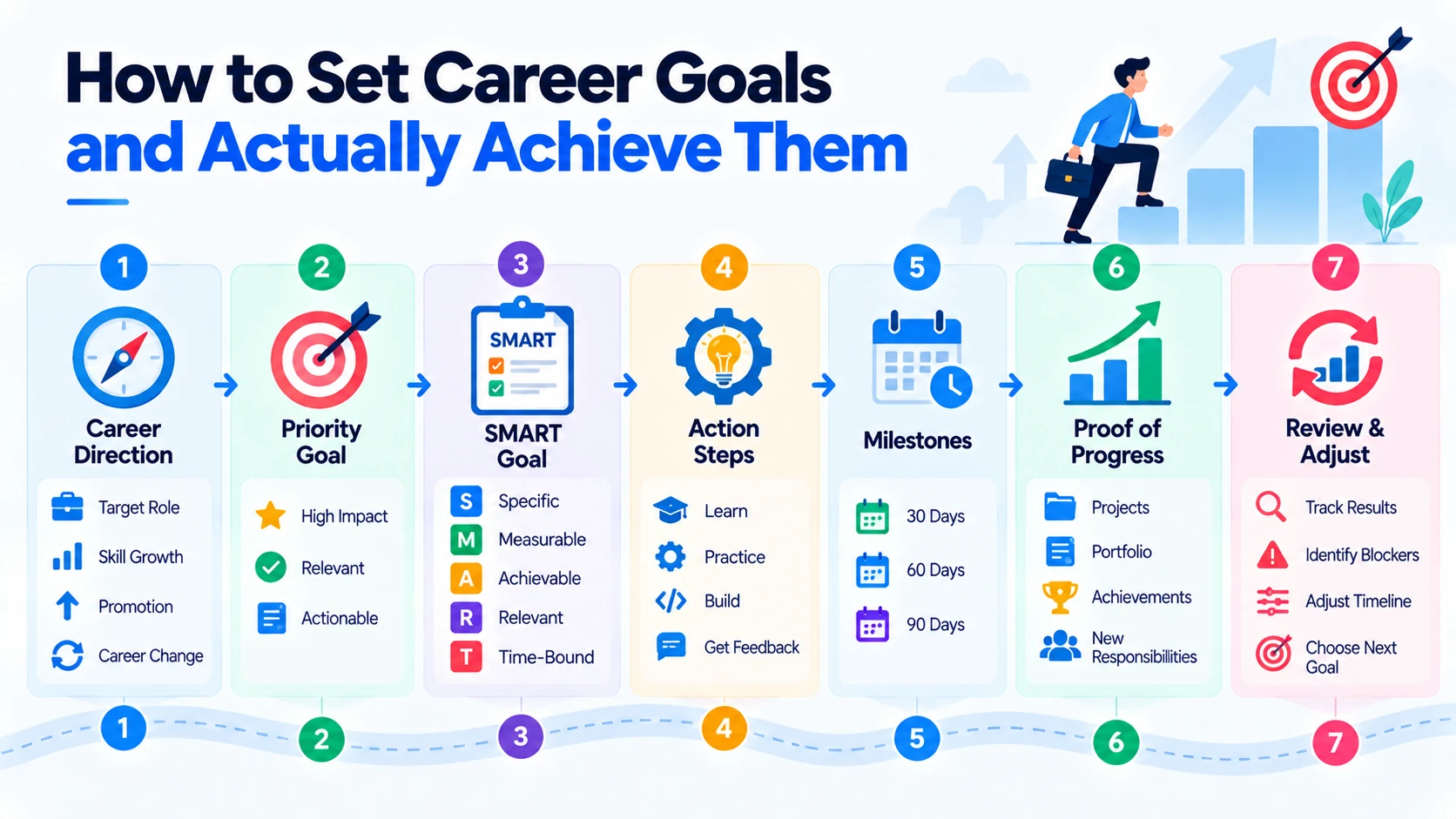
Career goals give your professional growth a clear direction.
Without a clear goal, it is easy to spend months learning random skills, applying for the wrong roles, or chasing opportunities that do not move you closer to the career you actually want.
A useful career goal should answer four questions:
- What do I want to achieve?
- Why does it matter?
- What actions will get me there?
- How will I know I am making progress?
This guide will show you how to set realistic career goals, turn them into SMART objectives, break them into action steps, track progress, and adjust them when your priorities change.
What Are Career Goals?
Career goals are professional outcomes you want to achieve over time.
- getting promoted
- moving into a new role
- learning a technical skill
- increasing responsibility
- changing careers
- becoming a specialist
- moving into leadership
- improving communication
- building a stronger portfolio
- earning a certification that supports a real career need
Coursera’s career goals guide also explains career goals as professional outcomes that can be short-term or long-term.
A useful way to think about career goals is:
Career Direction → Specific Goal → Action Steps → Milestones → Review
For example:
Become a senior WordPress developer.
That is a broad direction.
Improve PHP, plugin architecture, Git, and project ownership over the next 12 months to become ready for a senior WordPress developer role.
The second version is easier to plan around because it gives you a clearer outcome and areas to work on.
Why Career Goals Matter
Career goals help you make better decisions about your time, learning, and opportunities.
- focus on the skills that matter
- reduce random learning
- measure progress
- prepare for promotion
- plan a career switch
- identify meaningful milestones
- build evidence of growth
- avoid spending time on low-value activities
Career goals also fit inside a broader career development plan.
A career goal tells you what you want to achieve. A career development plan explains how you will get there.
Short-Term vs Long-Term Career Goals
| Short-Term Career Goals | Long-Term Career Goals |
| Usually weeks to months | Usually one year or more |
| Focus on immediate progress | Focus on broader direction |
| Easier to measure quickly | Require several milestones |
| Example: improve Git | Example: become a senior developer |
| Often skill- or project-based | Often role- or career-based |
How Short-Term and Long-Term Goals Work Together
Suppose your long-term goal is:
Become a senior WordPress developer.
Your short-term goals might be:
- improve PHP
- learn Git properly
- build two custom plugins
- understand WordPress hooks
- work with the REST API
- take ownership of a larger project
A structured WordPress developer roadmap can help connect these smaller technical goals to a broader development path.
The short-term goals support the long-term direction.
Step 1 — Define Your Career Direction
Before setting goals, decide what kind of growth you want.
- promotion
- technical specialization
- leadership
- freelancing
- career change
- higher salary
- stronger portfolio
- deeper expertise
- better work-life fit
Ask yourself:
- What role do I want next?
- What kind of work do I want more of?
- Which skills would create the biggest improvement?
- What responsibilities do I want to take on?
- What kind of work do I want less of?
- What would meaningful progress look like?
You do not need to know your entire career path. You only need enough direction to choose a useful next goal.
Step 2 — Choose One Priority Goal
Trying to improve everything at once usually creates weak progress. It is better to choose one main goal and let smaller goals support it.
Use this priority test:
- Is this goal relevant to my next role?
- Does it solve a real skill or career gap?
- Can I measure progress?
- Can I take action on it now?
- Will achieving it create a meaningful career benefit?
For example, if your immediate target is a WordPress development role, PHP, Git, portfolio work, and plugin development may be higher priority than learning an unrelated design tool. Focus creates better results than a long list of disconnected goals.
Step 3 — Turn It Into a SMART Career Goal
A useful career goal should be clear enough that you can act on it. The SMART framework helps with this.
- Specific
- Measurable
- Achievable
- Relevant
- Time-bound
Indeed’s SMART goals guide provides a practical breakdown of the Specific, Measurable, Achievable, Relevant, and Time-bound framework.
Specific
A goal should explain exactly what you want to improve or achieve.
Weak: Become better at coding.
Better: Improve JavaScript fundamentals and use them in two frontend projects.
Measurable
You should know what success looks like.
Weak: Learn more about WordPress.
Better: Build two working WordPress plugins and document them in my portfolio.
Achievable
A goal should be challenging but realistic. Trying to become a senior developer in four weeks is probably unrealistic. Improving one major skill and completing a project in three months may be much more practical.
Relevant
The goal should support your actual career direction. Do not pursue a skill only because it is popular. Ask whether it improves your chances of reaching your target role.
Time-Bound
A deadline creates focus. Instead of “Improve my PHP,” use: “Improve intermediate PHP skills and complete one custom WordPress plugin within four months.”
Weak vs SMART Career Goal Examples
Weak: Learn programming.
Better: Complete JavaScript fundamentals and build two small projects within four months.
Weak: Get promoted.
Better: Lead one cross-team project, improve stakeholder communication, and demonstrate senior-level responsibilities within nine months.
Weak: Improve testing skills.
Better: Build practical API testing and automation skills and apply them in one project within the next four months.
The better examples are easier to track and act on.
Step 4 — Break the Goal Into Action Steps
A goal becomes useful when it is translated into actions.
Suppose your goal is: Become job-ready for junior WordPress plugin development within six months.
Possible action steps:
- review PHP fundamentals
- understand plugin structure
- learn WordPress hooks
- build one small custom plugin
- use Git for version control
- learn basic plugin security
- document the project
- update your CV
- start applying for relevant roles
If your goal includes plugin development, a practical WordPress plugin development guide can help you turn that broad target into a real project.
Similarly, understanding WordPress hooks is useful because actions and filters are a core part of plugin development.
Action steps should be specific enough that you know whether you completed them.
Step 5 — Set Milestones
Milestones break a larger goal into smaller checkpoints. They help you avoid waiting until the final deadline to discover that you are behind.
Example goal: Build strong plugin development skills in six months.
Month 1
- review PHP
- improve Git basics
Month 2
- learn plugin structure
- understand actions and filters
Month 3
- build first plugin
Month 4
- improve security and settings
Month 5
- build second project
Month 6
- improve portfolio
- review job readiness
- begin targeted applications
Milestones make large goals easier to manage.
Step 6 — Build a Realistic Timeline
Timelines should create structure, not unnecessary pressure.
- weekly tasks
- monthly milestones
- quarterly reviews
Do not create a timeline based on what sounds impressive. Create one based on your current skill level, available time, goal difficulty, work and personal responsibilities, and access to practice opportunities.
30/60/90-Day Career Goal Example
First 30 Days
- define the goal
- identify the main skill gap
- choose learning resources
- decide on a practical project
- create a weekly schedule
Days 31–60
- complete structured learning
- work on a real project
- ask for feedback
- fix weak areas
- track progress
Days 61–90
- complete the project
- document results
- update your CV or portfolio
- review what improved
- set the next milestone
A 90-day goal does not need to transform your entire career. It should create meaningful progress.
Step 7 — Track Progress
Tracking helps you understand whether your actions are producing results.
- projects completed
- skills practiced
- applications sent
- interviews received
- responsibilities taken
- feedback received
- portfolio updates
- certifications completed
- measurable work improvements
Do not track activity just because it is easy to count.
Weak metric: Watched 40 videos.
Better metric: Built and documented one working project using the skill.
Track outcomes and evidence, not just activity.
Step 8 — Build Proof of Progress
Career growth is easier to demonstrate when you have evidence.
- portfolio projects
- GitHub repositories
- certificates
- case studies
- client results
- internal project contributions
- promotion responsibilities
- measurable performance improvements
- project ownership
For technical roles, practical work is often especially useful.
Weak: Learned WordPress hooks.
Stronger: Built a plugin using actions, filters, settings, and custom hooks.
Proof makes your progress visible to hiring managers, managers, clients, recruiters, and yourself.
Step 9 — Review and Adjust Your Goals
Career goals should be reviewed regularly.
Indeed’s guidance on career development goals also emphasizes revisiting professional goals as responsibilities, priorities, and career direction change.
Ask:
- Is this still the right goal?
- Am I making progress?
- What is blocking me?
- Is the timeline still realistic?
- Has the target role changed?
- Am I working on the right skills?
- What should I stop doing?
- What should I focus on next?
Changing a goal is not always failure. Sometimes your priorities change because you learned more about the role, the industry changed, your responsibilities changed, you discovered a better opportunity, or the original goal no longer fits. Good career planning is flexible.
Career Goal Examples
Technical Skill Goal
Improve PHP and build two WordPress plugins within six months.
Promotion Goal
Take ownership of one complex project and demonstrate the skills required for a senior role within nine months.
Career Change Goal
Build three portfolio projects and begin targeted applications for junior development roles within six months.
Leadership Goal
Lead weekly team planning and mentor one junior team member over the next quarter.
Communication Goal
Improve stakeholder communication by leading two project updates each month for three months.
Portfolio Goal
Complete and document three high-quality portfolio projects within five months.
Job Search Goal
Apply to 10 highly relevant roles each week for eight weeks while improving applications based on feedback.
The best goals are tied to a real outcome.
Career Goal Priority Matrix
| Goal | Impact | Urgency | Effort | Priority |
| Improve PHP | High | High | Medium | High |
| Build portfolio | High | High | High | High |
| Improve presentation skills | Medium | Medium | Medium | Medium |
| Learn design tools | Low | Low | Medium | Low |
This helps prevent low-value goals from taking attention away from high-impact work.
Career Goal Template
Career Direction: ________________________
Primary Goal: ________________________
Why It Matters: ________________________
Target Date: ________________________
Success Metric: ________________________
Required Skills: ________________________
Action Steps: ________________________
Milestones: ________________________
Proof of Progress: ________________________
Review Date: ________________________
Main Risks: ________________________
Next Action: ________________________
Keep the template simple. The goal is to create a tool you will use, not a document that looks impressive but gets ignored.
Common Career Goal Mistakes
Setting Vague Goals
Goals like “Become successful” are too broad. Define a real outcome.
Setting Too Many Goals
Ten goals usually create divided attention. Choose one main priority and a few supporting actions.
Creating Unrealistic Timelines
Aggressive deadlines can create frustration instead of progress. Use realistic milestones.
Choosing Goals That Do Not Support Your Career
Do not pursue a goal only because it is popular. Make sure it supports your actual direction.
Copying Someone Else’s Goals
Another person’s career path may not fit your strengths, location, background, or opportunities. Use examples as inspiration, not instructions.
Having No Milestones
A six-month goal without checkpoints is difficult to manage. Break it into monthly or quarterly milestones.
Measuring Only Activity
Courses completed or hours spent do not always equal career progress. Track practical outcomes.
Ignoring Proof
If you cannot show what improved, the goal may be harder to communicate to an employer or manager.
Changing Goals Too Frequently
Changing direction every week prevents meaningful progress. Give a good goal enough time to work before replacing it.
How Career Goals Fit Into a Career Development Plan
Career goals and career development plans are closely related.
A career goal defines an outcome. A career development plan includes the broader system around that goal.
That system may include:
- current position
- skill-gap analysis
- goals
- learning resources
- action steps
- milestones
- timeline
- proof of progress
- review process
Career Goal = Destination
Career Development Plan = Route
The goal gives your plan direction. The plan makes the goal achievable.
Career Goals Checklist
- ☐ My career direction is clear
- ☐ I selected one priority goal
- ☐ The goal is SMART
- ☐ I have specific action steps
- ☐ I set milestones
- ☐ My timeline is realistic
- ☐ I know how progress will be measured
- ☐ I have planned proof of progress
- ☐ I scheduled a review date
- ☐ I know the next action
Frequently Asked Questions
What are career goals?
Career goals are professional outcomes you want to achieve, such as learning a skill, earning a promotion, moving into a new role, or changing careers.
How do I set career goals?
Start by defining your career direction, choose one high-priority outcome, make it SMART, break it into actions and milestones, and review progress regularly.
What are examples of career goals?
Examples include improving a technical skill, getting promoted, building a portfolio, moving into leadership, changing careers, or completing a practical certification.
What is the difference between short-term and long-term career goals?
Short-term goals usually focus on immediate skills or milestones. Long-term goals describe broader professional outcomes that may take a year or longer.
What are SMART career goals?
SMART career goals are Specific, Measurable, Achievable, Relevant, and Time-bound.
How many career goals should I have at one time?
There is no fixed number, but one primary goal with a small number of supporting goals is often easier to manage than many competing priorities.
How often should I review my career goals?
For active goals, review progress monthly. Larger career goals can also be reviewed quarterly or whenever your circumstances change significantly.
Can career goals change over time?
Yes. Goals should change when new evidence, opportunities, responsibilities, or priorities make a different direction more useful.
Final Thoughts
Career goals work best when they are clear enough to guide action.
Do not start with a long list of things you want to improve. Start with one meaningful direction. Choose a specific outcome. Turn it into a SMART goal. Break it into practical actions. Set milestones. Build evidence. Review progress. Then adjust when necessary.
You do not need to know exactly where your career will be in ten years. You need a useful next goal and a system for moving toward it consistently.
The strongest career goals are not the most ambitious-sounding ones. They are the goals that help you focus, take action, build real evidence of progress, and move closer to the career you actually want.
