
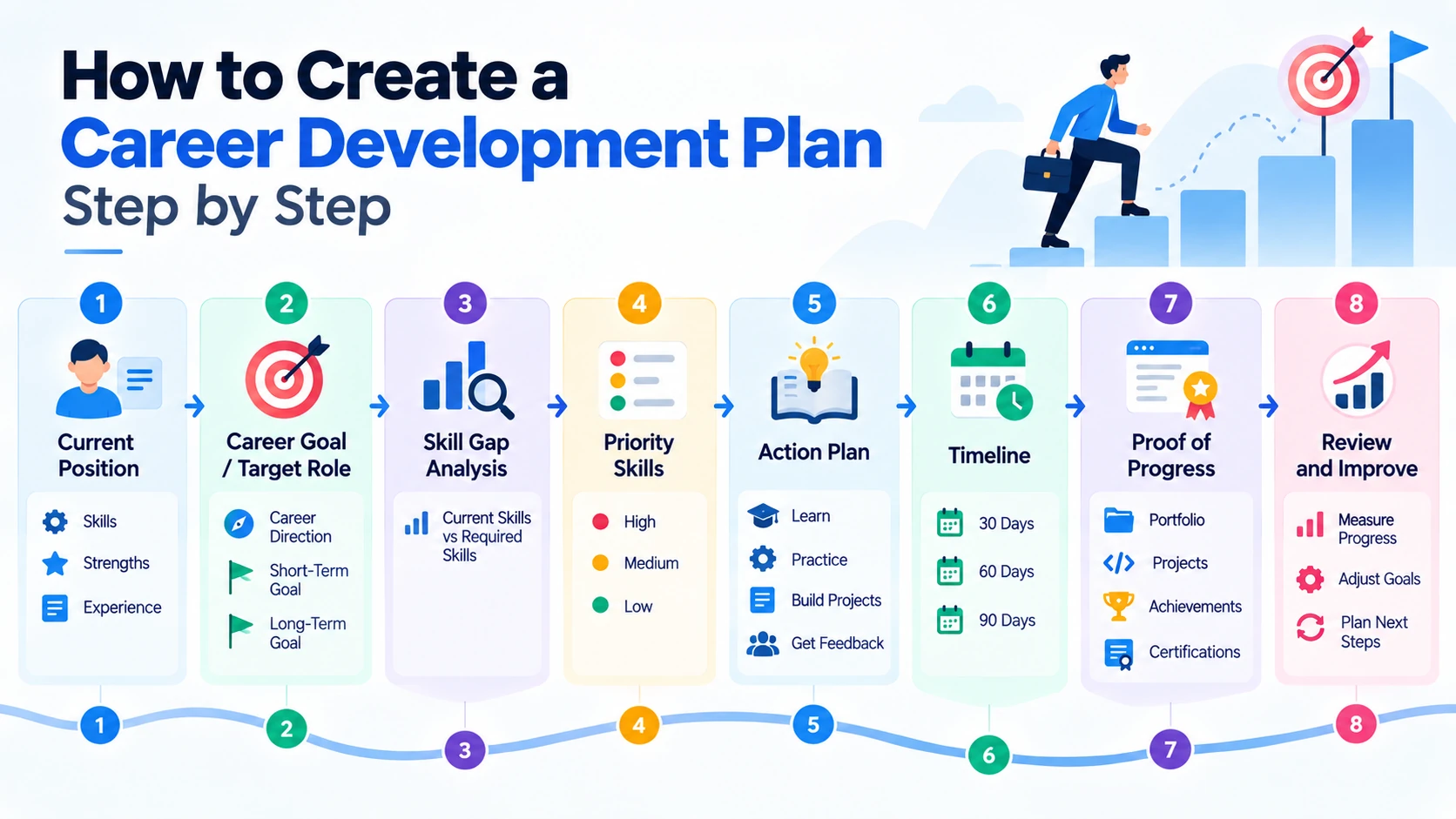
A career development plan gives you a clear path from where you are now to where you want to go professionally.
Instead of learning random skills, chasing every new certification, or changing direction every few months, a structured plan helps you identify your target role, understand your skill gaps, choose the right actions, and track progress over time.
A strong career development plan usually includes five core elements:
Current Position → Target Role → Skill Gap → Action Plan → Progress Review
This guide will show you how to build that plan step by step, with practical examples, a 30/60/90-day framework, and a reusable template.
What Is a Career Development Plan?
A career development plan is a structured roadmap that helps you move from your current professional position toward a specific career goal.
Indeed’s career development planning guide describes this process in terms of your starting point, destination, gap, and route.
It usually includes:
- your current role and strengths
- your target role or direction
- the skills you need to improve
- practical action steps
- a realistic timeline
- proof of progress
- regular review points
A career plan is more useful when it focuses on both direction and action.
For example, saying “I want to become a senior developer” is a career goal. A development plan explains how you will get there.
That might include:
- improving PHP
- learning Git properly
- building two production-level projects
- taking ownership of more complex tasks
- getting feedback from a senior developer
- reviewing progress every month
The goal gives you the destination. The plan gives you the route.
Why a Career Development Plan Matters
Without a clear plan, career growth can become reactive. You may keep taking courses, collecting certificates, changing tools, or applying for jobs without knowing whether those activities are moving you toward the right outcome.
A career development plan helps you:
- define a clear direction
- prioritize the most important skills
- avoid random learning
- prepare for promotion
- plan a career change
- build evidence of progress
- make better learning decisions
- measure whether your efforts are working
For example, if your long-term goal is WordPress development, a structured WordPress developer roadmap can help you identify which technical skills should come first instead of learning everything at once.
Career Development Plan vs Career Goals
| Career Goals | Career Development Plan |
| Defines the desired outcome | Defines how to reach the outcome |
| Can be broad | Should be specific |
| Focuses on destination | Focuses on destination and route |
| Example: become a team lead | Skills, milestones, actions, timeline |
| May stay unchanged for longer | Should be reviewed regularly |
A goal without a plan is often too vague to guide daily decisions. A plan turns that goal into concrete steps.
Step 1: Assess Where You Are Now
Before deciding where to go, understand your current position honestly. Start with:
- current job title
- main responsibilities
- technical skills
- soft skills
- recent achievements
- recurring weaknesses
- tasks you enjoy
- tasks you avoid
- feedback from managers or clients
Use this simple self-assessment:
Current Role: Junior WordPress Developer
Top Skills: HTML, CSS, basic PHP, WordPress admin
Biggest Strengths: Responsive UI, debugging simple frontend issues
Main Gaps: Plugin architecture, advanced PHP, REST API, Git workflow
Recent Wins: Completed two client landing pages and fixed performance issues
What I Want More Of: Backend WordPress development and custom plugin work
This gives you a realistic baseline. Without a baseline, it is difficult to know what progress actually looks like.
Step 2: Define Your Career Direction
Your next step depends on what kind of growth you want. Common directions include:
- promotion within your current field
- becoming a specialist
- moving into leadership
- changing careers
- moving from employment to freelancing
- switching industries
- building consulting expertise
You do not need your entire career mapped out. You only need enough direction to decide what matters next.
Short-Term vs Long-Term Direction
Short-term direction: Become a mid-level WordPress developer within 12 months.
Long-term direction: Move into senior development or technical leadership.
The short-term direction should guide your immediate actions. The long-term direction helps you avoid choices that take you too far away from where you eventually want to go.
Your plan should be directional, not rigid. Career goals can change as your experience grows.
Step 3: Set Clear Career Goals
A weak career goal is difficult to act on. For example: “Improve my skills.” This does not explain which skills, why they matter, what progress looks like, or when the goal should be achieved.
A better goal would be: “Complete two production-level WordPress plugin projects and apply for junior plugin developer roles within six months.” Good career goals should be specific, measurable, achievable, relevant to your career direction, and time-bound.
Another example:
Weak: Become better at software testing.
Better: Build practical experience in API testing and automation over the next four months and use those skills in at least one real or portfolio project.
The more clearly you define the outcome, the easier it becomes to identify the path.
Step 4: Identify Your Skill Gaps
A skill gap is the difference between what you can do now and what your target role requires. This is one of the most important parts of a career development plan.
Compare your current skills with the skills required for your target role. Skill gaps can include:
- technical skills
- tools
- domain knowledge
- communication
- leadership
- problem-solving
- project ownership
- documentation
- client communication
| Required Skill | Current Level | Target Level | Gap |
| PHP | Beginner | Intermediate | Medium |
| Git | Basic | Confident | Medium |
| REST API | Limited | Practical | High |
| Communication | Good | Strong | Small |
| Plugin Architecture | Beginner | Intermediate | High |
If you are targeting WordPress development, your WordPress developer roadmap can help identify the technical skills expected at each stage.
For other career paths, compare your current experience against credible role requirements, job descriptions, manager feedback, and actual work expectations rather than relying on one generic checklist.
Step 5: Prioritize the Skills That Matter Most
Do not try to close every skill gap at once. Not every missing skill has equal value. Prioritize based on:
- relevance to your target role
- how often the skill appears in real job requirements
- impact on your performance
- whether other skills depend on it
- how long it will take to build
- whether you can practice it immediately
Use a simple priority system:
High Priority: Essential for your target role.
Medium Priority: Useful, but not blocking progress.
Low Priority: Nice to have, but not urgent.
For example, if you want to become a WordPress plugin developer, PHP, hooks, and Git may be high priority; REST API and advanced JavaScript may be medium priority; graphic design may be low priority.
Step 6: Turn Skill Gaps Into Action Steps
A skill is too broad to act on. Turn it into specific actions.
Instead of “Learn PHP,” write:
- review PHP syntax and functions
- practice arrays and conditionals
- learn object-oriented PHP basics
- build one small PHP project
- use PHP inside a WordPress plugin
- review code with a more experienced developer
- document mistakes and improvements
Instead of “Improve communication,” write:
- lead one weekly team update
- explain one technical issue clearly to a non-technical teammate
- improve written task summaries
- ask for feedback after presentations or meetings
Action steps should be observable. You should be able to say whether you completed them or not.
Coursera’s career development plan guide also recommends connecting career goals with current skills, skills to develop, resources, and concrete action items.
Step 7: Build a Realistic Timeline
One of the biggest career planning mistakes is setting unrealistic timelines. Career growth usually requires repeated practice, not one intense week.
Break your plan into milestones. A useful structure is monthly, quarterly, six-month, and annual. For active development goals, a 30/60/90-day plan works well.
First 30 Days
- assess current skills
- define target role
- identify major gaps
- prioritize the top three skills
- choose learning resources
- decide what project you will build
Days 31–60
- complete structured learning
- start a practical project
- apply new skills in real tasks
- ask for feedback
- document challenges
- improve weak areas
Days 61–90
- complete or improve the project
- update CV
- update portfolio
- improve LinkedIn or professional profile
- discuss promotion with your manager
- start targeted job applications if appropriate
- review the next 90-day cycle
A 90-day plan does not mean you must completely change your career in three months. It gives you a manageable period for focused progress.
Step 8: Choose the Right Learning Resources
Career development often fails because people spend more time collecting learning resources than using them. Choose resources based on the skill you actually need.
Useful options include:
- official documentation
- structured online courses
- practical projects
- mentorship
- job shadowing
- code reviews
- communities
- books
- workshops
- internal company training
For example, if you are working toward plugin development, studying WordPress plugin development alongside practical project work is more useful than consuming disconnected tutorials.
One good resource plus consistent practice is better than ten unfinished courses.
Step 9: Build Proof of Progress
Learning is useful, but proof makes career growth visible. Depending on your field, proof can include:
- portfolio projects
- GitHub repositories
- certificates
- case studies
- work achievements
- project ownership
- performance improvements
- testimonials
- client results
- internal contributions
For example, “Learned WordPress hooks” is weak proof. “Built a custom plugin using actions, filters, and settings functionality” is stronger proof.
If hooks are part of your development goals, a practical WordPress hooks project can demonstrate that you understand more than just the theory.
Certificates can support your development, but a certificate alone does not always prove practical ability. Where possible, combine learning with real output.
Step 10: Review and Update Your Plan
A career development plan should not stay unchanged forever.
Current career-planning guidance also recommends tracking progress and re-evaluating goals as circumstances change.
For an active short-term plan, review every 30 days. For broader career direction, a quarterly review may be enough. Ask:
- What did I complete?
- What improved?
- What is still blocked?
- Which actions produced the most progress?
- Which skill is less important than I expected?
- Has my target role changed?
- Do I need a different timeline?
- What should I focus on next?
If your role, company, industry, or goals change, update the plan. Changing the plan based on evidence is not failure. It is part of good career planning.
Career Development Plan Example
Here is a simple example for a technology professional.
Current Position: Junior WordPress Developer
Target Role: Mid-Level WordPress Developer
Target Timeline: Six months
Current Strengths: HTML, CSS, responsive design, WordPress administration, basic PHP
Priority Skill Gaps: Intermediate PHP, plugin architecture, Git, REST API, debugging, WordPress hooks
Action Plan
Month 1
- assess PHP gaps
- improve Git basics
- study plugin structure
- review hooks
Month 2
- build a small custom plugin
- use actions and filters
- request code feedback
Month 3
- improve plugin architecture
- learn settings and security basics
- document project
Month 4
- study REST API
- build API-based functionality
- improve debugging workflow
Month 5
- build second project
- clean portfolio
- improve GitHub profile
Month 6
- review job readiness
- update CV
- apply for relevant roles
- discuss promotion if already employed
Proof of Progress
- two working plugins
- GitHub activity
- improved code quality
- better debugging speed
- stronger portfolio
- real project contribution
This example connects well with a WordPress developer roadmap, practical WordPress plugin development, and understanding WordPress hooks.
Career Development Plan Template
Use this template for your own plan:
Current Role: ________________________
Target Role: ________________________
Target Date: ________________________
Top Strengths: ________________________
Priority Skill Gaps: ________________________
Career Goals: ________________________
Action Steps: ________________________
Learning Resources: ________________________
Practical Projects: ________________________
Proof of Progress: ________________________
Review Date: ________________________
Main Risks or Blockers: ________________________
Next Milestone: ________________________
Keep the template simple enough that you will actually use it. A complicated plan that is never reviewed is less useful than a simple plan you follow consistently.
Common Career Development Planning Mistakes
Setting Vague Goals — Goals such as “improve my career” are difficult to measure. Be specific about the role, skill, or outcome.
Trying to Learn Everything — Too many goals divide your attention. Choose the skills with the highest impact.
Copying Someone Else’s Career Path — Another person’s path may not match your background, strengths, location, or goals. Use other career paths for ideas, not as fixed instructions.
Collecting Certifications Without a Reason — A certification should support a real career goal. Do not pursue one only because it is popular.
Learning Without Building — Knowledge becomes more valuable when you apply it. Use projects, work tasks, case studies, or practical exercises.
Ignoring Soft Skills — Technical ability alone may not be enough for senior roles. Communication, ownership, problem-solving, leadership, and collaboration often become more important as your career progresses.
Having No Timeline — Without deadlines or review dates, goals are easy to postpone.
Never Reviewing the Plan — A career plan should evolve with your experience. Review it regularly.
How to Use a Career Development Plan for a Promotion
If your goal is promotion, start with the role you want. Identify:
- responsibilities of the next role
- skills expected
- performance standards
- leadership expectations
- evidence you already have
- gaps you still need to close
Then build your plan around visible contributions. For example:
- own a more complex project
- mentor a junior teammate
- improve a process
- document measurable results
- develop a missing technical skill
- ask your manager what evidence is required for promotion
Do not wait until the promotion conversation to start building evidence. Use the plan to prepare in advance.
How to Use a Career Development Plan for a Career Change
Career changes require a slightly different approach. Start by identifying transferable skills.
For example, a QA professional moving into development may already have debugging skills, product understanding, attention to detail, API knowledge, and technical communication.
Then identify the true gaps. You may need:
- programming fundamentals
- portfolio projects
- framework knowledge
- Git
- interview preparation
Use low-risk experiments before making a major move. Examples include building a small project, taking on a cross-functional task, freelancing part-time, contributing to an internal project, or talking to professionals already in the target field.
This helps you test whether the new direction actually fits you.
Career Development Plan Checklist
- Current Position: I understand my current position.
- Career Direction: I have defined a clear career direction.
- Goals: My goals are specific.
- Skill Gaps: I know my major skill gaps.
- Prioritization: I have prioritized the important skills.
- Action Steps: I have specific action steps.
- Timeline: I have a realistic timeline.
- Resources: I have chosen learning resources.
- Proof of Progress: I have planned practical proof of progress.
- Review Date: I have a review date.
- Next Milestone: I know my next milestone.
Frequently Asked Questions
What is a career development plan?
A career development plan is a structured roadmap that identifies your current position, target career direction, skill gaps, action steps, timeline, and progress review process.
How do I create a career development plan?
Start by assessing your current skills, defining your target role, identifying skill gaps, prioritizing the most important skills, creating action steps, and setting review dates.
What should be included in a career development plan?
A good plan should include your current role, target role, goals, strengths, skill gaps, actions, resources, timeline, proof of progress, and review dates.
How often should I update my career development plan?
For active goals, review your plan monthly. For broader career direction, review it at least every few months or whenever your role or goals change significantly.
What is the difference between career goals and a career development plan?
Career goals describe what you want to achieve. A career development plan explains how you will achieve it.
Can a career development plan help with promotion?
Yes. It can help you identify the skills and evidence needed for the next role, then build a structured path toward those requirements.
How do I identify career skill gaps?
Compare your current skills with the skills required for your target role. Use job descriptions, manager feedback, role expectations, and practical performance as evidence.
How long should a career development plan be?
There is no fixed length. It should be detailed enough to guide your actions but simple enough to review regularly.
Final Thoughts
A good career development plan should make your next steps clearer, not more complicated.
Start with where you are now. Define where you want to go. Identify the gap. Choose the most important actions. Set a realistic timeline. Then review your progress regularly.
You do not need to predict your entire career. You only need a practical direction and a system for moving forward.
The strongest career plans are not the ones with the most goals. They are the ones that help you focus on the right goals, build real skills, create proof of progress, and adjust when your career changes.
