
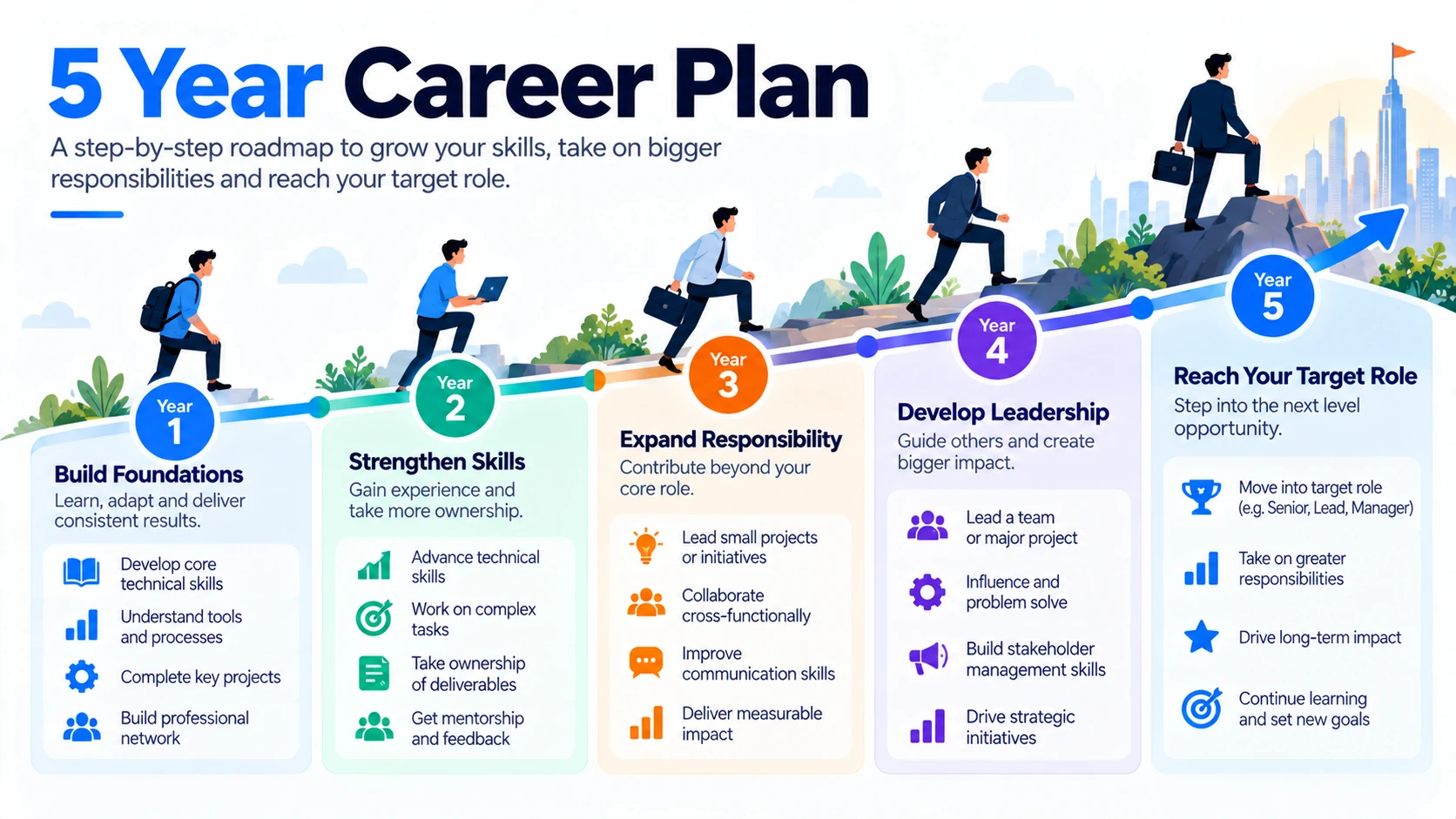
A 5 year career plan gives you a clearer direction for where you want your career to go and what you need to do to get there. It does not mean predicting exactly what your job title, salary, or company will be five years from now. A better way to think about it is as a flexible roadmap:
Direction → Skills → Milestones → Evidence → Review → Adjust
A practical 5 year career plan should help you decide what role or level you want to reach, which skills you need to build, what experience matters, and how you will measure progress along the way.
What Is a 5-Year Career Plan?
A 5-year career plan is a structured roadmap that connects your current position with a longer-term career direction.
It can include:
- Target Role
- Desired Responsibilities
- Skills to Build
- Experience to Gain
- Yearly Milestones
- Evidence of Progress
- Promotion or Job-Change Decisions
- Review Points
The purpose is not to create a rigid prediction.
Your plan should be flexible enough to change if:
- New Opportunities Appear
- Your Interests Change
- Your Industry Changes
- Your Skill Priorities Change
- Your Personal Circumstances Change
A useful plan gives you direction without locking you into one path.
Why Build a 5-Year Career Plan?
Without a long-term plan, career decisions can become reactive. You may accept roles because they are available, complete courses without a clear reason, or wait for promotions without knowing what skills or responsibilities are required.
A 5 year career plan can help you:
- Create Clear Direction
- Prioritize Important Skills
- Reduce Random Career Decisions
- Prepare for Promotions
- Identify Skill Gaps Early
- Choose Better Learning Opportunities
- Build Relevant Experience
- Track Career Progress
- Decide When a Job Change Makes Sense
Your broader career goals should give the plan its direction. The plan then turns those goals into smaller stages you can work on over time.
Indeed’s career planning guidance also emphasizes setting long-term goals, breaking them into shorter steps, and revisiting the process as your career evolves.
Step 1: Define Your 5-Year Career Direction
Start with direction, not job titles.
Ask yourself:
- What Kind of Work Do I Want to Do?
- What Type of Problems Do I Want to Solve?
- Do I Want to Become a Specialist or a Leader?
- Which Industry Interests Me?
- What Level of Responsibility Do I Want?
- What Type of Work Environment Fits Me?
- What Kind of Career Growth Matters Most?
Avoid making the goal unnecessarily rigid.
Weak: I must become CTO within exactly five years.
Better: I want to move into a senior technical role with stronger project ownership, architecture responsibilities, and mentoring experience.
This gives you a target while leaving room for realistic changes.
Step 2: Define Your Year 5 Target
Now make the end point more specific.
Your Year 5 target might include:
- Job Title
- Career Level
- Scope of Responsibility
- Technical Capability
- Leadership Responsibility
- Industry Specialization
- Compensation Direction
- Work Environment
Compensation can be part of the plan, but it should be treated as one factor alongside responsibility, capability, and role fit.
Example
Current Role: Junior Developer
Year 5 Target: Senior Developer or Technical Lead
Desired Capabilities:
- Strong Technical Skills
- Project Ownership
- Architecture Understanding
- Mentoring Experience
- Stakeholder Communication
- Independent Decision-Making
You do not need to know the exact company or job title. The important thing is understanding the level of capability you want to reach.
Step 3: Assess Where You Are Today
A strong career plan starts with an honest current-state assessment.
Review:
- Current Role
- Current Skills
- Experience Level
- Responsibilities
- Strengths
- Weaknesses
- Portfolio
- Certifications Where Relevant
- Professional Network
- Leadership Exposure
- Communication Skills
Then compare your current position with your Year 5 target.
| Area | Current Position | 5-Year Requirement | Gap |
| Technical Depth | Junior | Advanced | High |
| Project Ownership | Limited | Strong | High |
| Communication | Good | Strong | Medium |
| Mentoring | None | Regular | High |
| Architecture | Basic | Strong | High |
A skill gap analysis helps you identify which differences matter most. The goal is not to create the longest possible list of weaknesses. The goal is to identify the few gaps that are likely to affect your next career steps.
Step 4: Identify the Most Important Skill Gaps
Not every skill gap deserves the same attention.
Prioritize gaps using three questions:
- How Important Is This Skill?
- How Large Is the Gap?
- How Relevant Will It Be in the Future?
Importance + Gap Size + Future Relevance
Common categories include:
- Core Technical Skills
- Communication Skills
- Leadership Skills
- Project Ownership
- Business Knowledge
- Industry Knowledge
- Strategic Thinking
- Professional Networking
For example, if your Year 5 goal is Senior Developer, learning an unrelated design tool may be less important than improving architecture, code quality, mentoring, and stakeholder communication.
Step 5: Break the Plan Into Yearly Milestones
A long-term goal becomes easier when you divide it into annual stages. A practical 5 year career plan might look like this:
Year 1- Build the Foundation
The first year should focus on fixing major weaknesses and strengthening core capability.
- Strengthen Core Skills
- Improve Work Quality
- Close Critical Skill Gaps
- Learn Better Tools
- Build One or Two Strong Projects
- Improve Documentation
- Start Tracking Achievements
- Ask for Regular Feedback
The goal is to become stronger and more consistent in your current role.
Year 2- Build Capability
Year 2 should focus on becoming more independent.
- Handle Larger Tasks
- Work With Less Supervision
- Improve Technical Depth
- Improve Communication
- Take Ownership of Features
- Build a Stronger Professional Network
- Start Supporting Less-Experienced Colleagues
At this stage, your work should show more confidence and reliability.
Year 3- Increase Responsibility
By Year 3, the focus should move from execution to ownership.
- Lead Small Projects
- Own Deliverables
- Mentor Junior Team Members
- Work Directly With Stakeholders
- Improve Decision-Making
- Understand Business Priorities
- Handle More Complex Problems
This is where you begin building evidence for higher-level roles.
Year 4- Position Yourself for the Target Role
Year 4 should prepare you for the final transition.
- Own Complex Projects
- Build Leadership Evidence
- Take Strategic Responsibilities
- Close Remaining Skill Gaps
- Build Promotion Evidence
- Strengthen Your Professional Reputation
- Evaluate Internal and External Opportunities
If your current company has a realistic growth path, this may also be the right time to prepare for how to ask for a promotion.
Year 5- Move Into the Target Role
The final year should focus on reaching or moving close to the target.
- Apply for the Target Role
- Negotiate Scope and Responsibility
- Demonstrate Senior-Level Readiness
- Take Full Ownership
- Review Compensation
- Review the Next Career Direction
Reaching the exact title is less important than reaching the expected capability, scope, and responsibility level.
Even if you do not reach the exact title by Year 5, the real question is whether your capability and responsibilities have moved significantly closer to the target.
5-Year Career Plan Example
Here is a simple example for a developer:
| Year | Main Focus | Key Actions | Evidence |
| Year 1 | Foundation | Core Skills, Projects | Better Output |
| Year 2 | Capability | Larger Tasks, Independence | Stronger Delivery |
| Year 3 | Responsibility | Lead Small Projects | Ownership |
| Year 4 | Positioning | Leadership, Complex Work | Promotion Readiness |
| Year 5 | Target Role | Senior-Level Scope | Role Transition |
Step 6: Turn Each Year Into Measurable Milestones
Avoid vague goals.
Weak: Improve communication.
Better: Lead monthly project updates independently for six months.
Weak: Learn leadership.
Better: Mentor one junior teammate and lead one small project.
Useful milestone categories include:
- Skills
- Projects
- Responsibility
- Communication
- Leadership
- Portfolio
- Networking
- Promotion Readiness
A good milestone should show what you will do and what evidence will prove progress.
Step 7: Build a Development Plan for Each Major Gap
Once you know the major gaps, define how you will close them.
| Skill | Action | Evidence |
| Git | Use Daily in Projects | Fewer Workflow Errors |
| Communication | Lead Updates | Manager Feedback |
| Architecture | Design Small Systems | Reviewed Design Documents |
| Mentoring | Support Junior Teammate | Feedback and Outcomes |
Your career development plan should translate long-term goals into specific learning and work actions.
For each gap, define:
- Target Level
- Learning Method
- Practical Application
- Evidence
- Review Date
This prevents learning from becoming disconnected from career progress.
Coursera’s career development guidance also frames a development plan as a way to connect career goals with a practical path for reaching them.
Step 8: Decide When Promotion, Job Change, or Career Change Makes Sense
A 5-year plan should not assume that your current role or employer will always remain the best option. You may eventually need to choose between three paths.
Promotion
A promotion may make sense when:
- Your Current Company Offers Growth
- The Next Role Exists
- Promotion Criteria Are Clear
- You Are Building Relevant Evidence
- Compensation and Scope Are Competitive
Job Change
A job change may make sense when:
- Your Skills Have Grown
- Your Current Role Has Become Too Limited
- Internal Opportunities Are Weak
- Another Employer Offers Better Scope
- You Need Different Experience
Career Change
A career change may make sense when the long-term direction itself no longer fits your interests, strengths, or goals.
The point is not to decide everything today. The point is to recognize the decision points before they arrive.
Step 9 — Track Evidence, Not Just Activity
One of the biggest career-planning mistakes is confusing activity with progress.
Weak evidence:
- Completed a Course
- Watched Tutorials
- Attended a Webinar
Stronger evidence:
- Built a Project
- Led a Feature
- Improved a Process
- Mentored a Colleague
- Received Positive Feedback
- Took On More Responsibility
- Solved a Complex Problem
- Improved Quality or Delivery
Track capability and impact, not just learning activity.
Learning activity becomes meaningful career progress when it results in stronger capability, better output, or increased responsibility.
This makes it easier to see whether your plan is working. It also gives you useful evidence for performance reviews, promotions, CV updates, and interviews.
Step 10 — Review Your Career Plan Regularly
A plan that is never reviewed quickly becomes outdated. Use two levels of review.
Quarterly Quick Review
Ask:
- What Progress Did I Make?
- Which Milestones Are Delayed?
- What New Opportunities Appeared?
- Which Skills Need More Attention?
Annual Full Review
Ask:
- Is My Year 5 Target Still Relevant?
- What Changed During the Year?
- Which Gaps Remain?
- Which Goals Should Move Earlier?
- Which Goals Should Move Later?
- Do I Need a Different Direction?
You should also review your plan after major events such as:
- Promotion
- Job Change
- Layoff
- Career Change
- Major Personal Change
- Industry Shift
The plan should support your career, not control it.
What If Your 5-Year Plan Changes?
Your plan will probably change. That is normal.
Possible reasons include:
- New Opportunity
- Industry Change
- New Interests
- Family Responsibilities
- Burnout
- Better Career Fit
- Economic Changes
- Unexpected Skill Strengths
Changing your plan does not mean the original plan failed. A useful 5 year career plan should help you make better decisions when new information appears.
For example, you may begin with a goal of becoming a Technical Lead and later discover that you prefer deep technical specialization. The new plan could move toward Senior Engineer or Architect instead. That is adjustment, not failure.
Harvard Business Review’s career-transition guidance reinforces the value of exploring possibilities and adapting your direction as you learn more about what fits.
Common 5-Year Career Planning Mistakes
Making the Plan Too Rigid: Do not treat every year as a fixed contract. Careers change.
Focusing Only on Job Titles: A title without stronger skills or responsibility may not represent real growth.
Ignoring Skill Gaps: Long-term goals need realistic capability development.
Setting Too Many Goals: Too many priorities reduce focus.
Not Tracking Evidence: If you cannot show what improved, it is difficult to know whether the plan is working.
Ignoring Financial Needs: Career decisions should also account for compensation and personal responsibilities.
Ignoring Personal Priorities: Growth should fit your broader life, not only your job title.
Never Reviewing the Plan: A plan based on outdated assumptions loses value.
Copying Someone Else’s Career Path: Another person’s timeline may not fit your skills, industry, or opportunities.
Treating Courses as Progress: Learning matters, but capability needs practical evidence.
Assuming Promotions Happen Automatically: Strong performance does not always lead to automatic advancement. You may still need to present your case clearly.
5-Year Career Plan Template
Current Role: ________________________
Year 5 Target: ________________________
Key Skills Required: ________________________
Current Skill Gaps: ________________________
Year 1 Milestones: ________________________
Year 2 Milestones: ________________________
Year 3 Milestones: ________________________
Year 4 Milestones: ________________________
Year 5 Milestones: ________________________
Evidence I Will Track: ________________________
Review Date: ________________________
5-Year Career Plan Checklist
- Current Position Is Clear
- Year 5 Direction Is Defined
- Target Role Is Realistic
- Skill Gaps Are Identified
- Yearly Milestones Are Defined
- Development Actions Are Assigned
- Evidence of Progress Is Defined
- Promotion or Job-Change Points Are Considered
- Review Dates Are Scheduled
- Backup Path Is Considered
- Plan Can Be Adjusted
How a 5-Year Career Plan Fits Into Your Career Growth Strategy
Career Goals → 5-Year Career Plan → Skill Gap Analysis → Career Development Plan → Promotion or Career Change Decisions
Your career goals define the direction. Your 5 year career plan turns that direction into a longer-term roadmap. Your skill gap analysis identifies what is missing. Your career development plan turns those gaps into practical actions. Your promotion or career change decisions determine how you move into the next stage.
This creates a complete career-growth system instead of a collection of unrelated goals.
Frequently Asked Questions
What Is a 5-Year Career Plan?
A 5-year career plan is a flexible roadmap that connects your current position with a longer-term career direction through skills, milestones, experience, and regular reviews.
How Do I Create a 5-Year Career Plan?
Define your long-term direction, choose a realistic Year 5 target, assess your current position, identify skill gaps, create yearly milestones, and review the plan regularly.
What Should I Include in a 5-Year Career Plan?
Include your target role or direction, required skills, current gaps, yearly milestones, development actions, evidence of progress, and review dates.
Should a 5-Year Career Plan Be Detailed?
It should be detailed enough to guide decisions but flexible enough to change. Avoid trying to predict every job title or event.
What If My Career Goals Change?
Update the plan. Changing direction based on new information, priorities, or opportunities is normal.
How Often Should I Review My Career Plan?
A quick quarterly review and a deeper annual review can help keep the plan relevant. Major career or personal changes may also require an immediate review.
What Is a Good 5-Year Career Goal?
A useful goal describes the type of capability, responsibility, or role you want to reach rather than relying only on a specific title. For example: Move into a senior technical role with project ownership, mentoring responsibilities, and stronger architecture skills.
Can I Make a 5-Year Career Plan If I Am Unsure About My Future Role?
Yes. You can plan around a general direction such as leadership, technical specialization, management, or a specific industry. Your target can become more specific as you gain experience.
Final Thoughts
A strong 5 year career plan should give you direction without making your future unnecessarily rigid.
Start with where you want to go. Understand where you are today. Identify the most important gaps. Break the journey into realistic yearly milestones. Track evidence of capability and impact. Then review and adjust the plan as your career evolves.
The goal is not to predict the next five years perfectly. The goal is to make more intentional career decisions during those five years.
