
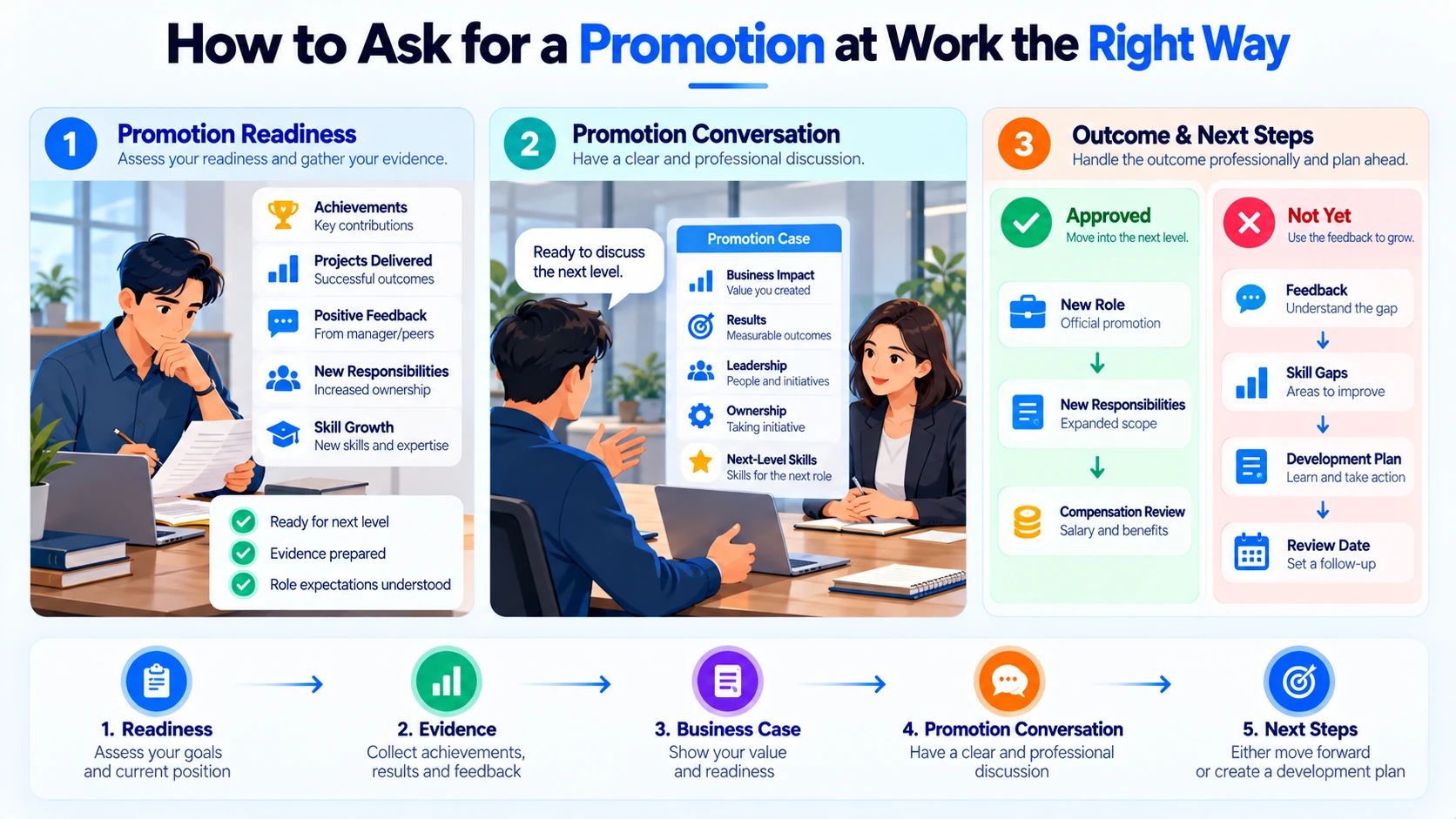
Knowing how to ask for a promotion can be difficult because the conversation needs more than confidence.
A strong promotion request is usually based on three things:
- Evidence of your impact
- Readiness for the next level
- A clear conversation with your manager
Simply working hard or staying at a company for a long time does not automatically make the case.
Readiness → Evidence → Business Case → Timing → Conversation → Follow-Up
This guide will show you how to prepare, what to say, how to handle a “not yet” response, and what to do after the meeting.
When Should You Ask for a Promotion?
The best time to ask for a promotion is when you have evidence that your responsibilities, results, and capability have moved beyond your current role.
Company review cycles, budget timing, and promotion policies can also affect when a decision is possible, even when your case is strong.
Good signs include:
- Consistently strong performance
- Responsibilities have increased
- You are handling work normally expected at the next level
- You have delivered measurable results
- You have received positive feedback
- You are taking ownership without constant supervision
- You are solving more complex problems
- You are supporting other team members
- You understand what the next role requires
Indeed’s promotion timing guide also emphasizes expanded responsibilities, measurable results, and strong performance as useful signals that it may be time to discuss advancement.
Signs You May Be Ready
- I consistently meet expectations
- I have taken on higher-level responsibilities
- I can show specific achievements
- I understand the next role
- I have positive feedback
- I work independently on important tasks
- I help solve team problems
- My major skill gaps are manageable
A skill gap analysis can help you identify whether the difference between your current capability and the next role is small enough to make a strong promotion case.
When You Should Wait Before Asking
Sometimes the best move is to prepare first.
You may want to wait if:
- You have recent performance problems
- You cannot explain what value you have added
- You do not understand the next role
- Your manager has repeatedly raised unresolved concerns
- The company is going through major instability
- Your only reason is that you have been there for a certain amount of time
- You have just had a major conflict or missed an important commitment
This does not mean you should avoid the conversation forever. It means you should strengthen the case first.
Step 1: Define Exactly What Promotion You Want
Do not go into the conversation with only: “I want a promotion.” Be specific.
- target title
- target level
- responsibilities
- reporting expectations
- team scope
- whether compensation should also change
For example:
I’d like to discuss moving from Junior Developer to Mid-Level Developer and understand whether I’m meeting the expectations for that level.
This gives the conversation a clear direction and helps your manager respond with specific feedback.
Step 2: Understand the Requirements of the Next Role
Before asking for a promotion, understand what the next level actually requires.
- Internal job descriptions
- Role frameworks
- Competency documents
- Responsibilities of people already in that role
- Feedback from your manager
- Previous promotion criteria
- Performance expectations
| Current Role | Next Role |
| Completes assigned tasks | Owns projects |
| Needs frequent guidance | Works independently |
| Limited stakeholder contact | Communicates with stakeholders |
| Follows solutions | Helps shape solutions |
| Focuses on individual work | Supports wider team outcomes |
You should be able to explain not only why you are good at your current job, but why you are ready for the next one.
Your broader career goals should also support the promotion you are asking for.
Step 3: Review Your Skill Gaps
Now compare your current capability with the next role.
- Which requirements do I already meet?
- Where do I have evidence?
- What is still missing?
- Which gaps are small?
- Which gaps are significant?
| Requirement | Evidence | Gap |
| Project ownership | Led Project X | None |
| Communication | Weekly client updates | Small |
| Architecture decisions | Limited experience | Medium |
| Mentoring | Supported junior teammate | Small |
A skill gap analysis helps make this comparison more objective.
You do not need to eliminate every gap before asking for a promotion. But you should know what the remaining gaps are and be able to discuss them honestly.
Step 4: Build Evidence of Your Impact
This is one of the most important parts of the process.
Do not build your promotion request around: “I work hard.” Instead, collect evidence.
- Projects delivered
- Revenue supported
- Costs reduced
- Bugs reduced
- Time saved
- Processes improved
- Responsibilities added
- Customer problems solved
- Team members supported
- Deadlines met
- Incidents prevented
- Quality improvements
- Client feedback
Weak: I have been doing a lot more lately.
Better: I took ownership of two client projects, reduced recurring support issues, and started handling deployment tasks independently.
Specific evidence makes the conversation stronger.
Step 5: Build Your Promotion Business Case
What I’ve Done → Impact → Next-Level Behavior → Why I’m Ready
For example:
Over the last six months, I’ve taken ownership of two projects, reduced recurring production issues, and started supporting junior developers. These responsibilities are closer to the expectations of the mid-level role, so I’d like to discuss whether I’m ready to move to that level.
Harvard Business Review’s guide to asking for a promotion also recommends preparing a clear case before speaking with your manager and being specific about what you want.
Notice what this does not focus on: personal expenses, frustration, how long you have waited, or what a coworker earns.
Your manager is more likely to evaluate contribution, scope, consistency, readiness, and business value.
Step 6: Choose the Right Time
Timing cannot guarantee a promotion, but poor timing can make the conversation harder.
Good moments may include:
- after a successful project
- after strong performance feedback
- during a review period
- when responsibilities have recently expanded
- before workforce or budget planning, if your company follows a known cycle
- when your manager can give the conversation proper attention
Avoid asking in a corridor, during a rushed meeting, after a stressful incident, in the final two minutes of another meeting, immediately after a major mistake, or when your manager is dealing with an urgent crisis.
A promotion conversation deserves dedicated time.
Step 7: Schedule a Proper Promotion Meeting
Do not surprise your manager with a major promotion request in an unrelated meeting if you can avoid it.
A simple message:
I’d like to schedule some time to discuss my current responsibilities, progress, and potential path to the next level. Could we set aside 30 minutes this week?
This gives your manager time to prepare and signals that you want a professional career discussion, not a casual complaint.
Indeed’s how to ask for a promotion guide provides a practical framework for preparing your case, choosing the right time, starting the conversation, and following up.
Step 8: What to Say When Asking for a Promotion
The conversation should be direct but professional.
Use this structure:
1. State why you wanted the meeting
2. Summarize your recent responsibilities
3. Explain your impact
4. Connect your work to the next role
5. Ask clearly
6. Invite feedback
A practical example:
Over the past several months, I’ve taken on more ownership in project delivery, handled several issues independently, and supported the team in areas beyond my current responsibilities. Based on the expectations for the next level, I’d like to discuss whether I’m ready for promotion and what next steps you would recommend.
This is stronger than: I think I deserve a promotion. Because it gives your manager something concrete to evaluate.
Step 9: How to Discuss Salary With the Promotion
A promotion and a salary increase are related, but they are not exactly the same conversation.
First establish whether the role is changing, what the new responsibilities are, and when the change would take effect.
Then discuss compensation.
A professional way to ask:
If the role change moves forward, I’d also like to understand the compensation range associated with that level.
You can also ask: How would compensation be reviewed as part of this promotion?
Keep the discussion factual and do not make the salary conversation only about personal financial needs.
Step 10: What to Do If Your Manager Says “Not Yet”
A “not yet” response can still be useful. Do not leave the meeting with only: “Keep working hard.” That is too vague.
Ask for specifics:
- What gaps remain?
- What responsibilities do I need to demonstrate?
- What results would show readiness?
- Which skills should I improve?
- What should I own independently?
- When should we review this again?
A strong follow-up question is:
Could we define two or three specific outcomes I should demonstrate over the next three months and set a review date?
A structured career development plan can help you turn that feedback into actions, milestones, and evidence.
What If the Answer Is No?
“Not Yet”
This means there may be a realistic path. You need clear gaps, clear milestones, a review date, and an evidence plan.
“No Clear Path”
If your manager cannot explain what you need to improve, when you could progress, whether the next role exists, or what criteria matter, you may need to explore internal mobility, a different team, a different role, or longer-term external opportunities.
Do not immediately resign because one promotion request was declined. First understand whether there is a credible path forward.
Promotion Without a Salary Increase
Sometimes an employer may offer a new title or responsibilities without an immediate salary increase.
Before accepting, clarify:
- Is the change temporary or permanent?
- Will compensation be reviewed later?
- When is the review date?
- What is the new scope?
- Does the title create meaningful future value?
- Are you being asked to do significantly more work without a clear plan?
A promotion without immediate compensation is not automatically bad. But it should not be vague.
If compensation will be reviewed later, try to establish a specific timeline.
How to Follow Up After the Promotion Conversation
Do not treat the meeting as the end of the process.
If the promotion is approved, confirm:
- New title
- Responsibilities
- Effective date
- Compensation
- Reporting structure
- Transition expectations
If the answer is pending or “not yet,” send a short recap.
Example:
Thanks for the discussion today. My understanding is that I should focus on improving project ownership and stakeholder communication, and we’ll review promotion readiness again in three months.
This reduces misunderstandings and creates a clear reference point for the next conversation.
Promotion Readiness Example
Current Role
Junior Developer
Target Role
Mid-Level Developer
Evidence
- Delivered two projects independently
- Improved deployment workflow
- Resolved recurring production issues
- Supported junior team members
- Communicated directly with stakeholders on project updates
Remaining Gaps
- Stronger architecture decisions
- More complex project planning
- More consistent stakeholder communication
Promotion Case
Over the last six months, I’ve taken ownership of two projects, improved our deployment process, and started supporting other team members. I’m also handling more stakeholder communication than before. I’d like to discuss whether I’m meeting the expectations for the mid-level role and what I should demonstrate next if there are still gaps.
This is direct without being aggressive.
Promotion Readiness Checklist
- Target role is clear
- Promotion criteria are understood
- Achievements are documented
- Business impact is identified
- Skill gaps are reviewed
- Examples are prepared
- Timing is appropriate
- Dedicated meeting is scheduled
- Salary question is prepared
- Follow-up plan is ready
Common Mistakes When Asking for a Promotion
Asking Based Only on Tenure: Time in a role can matter, but it is not enough by itself. Focus on contribution and readiness.
Comparing Yourself Aggressively With Coworkers: Build your case around your own results rather than attacking a coworker’s performance.
Threatening to Leave: Do not use resignation as leverage unless you are genuinely prepared to leave.
Making a Vague Request: Be clear about the level or role you want.
Having No Evidence: Prepare specific achievements and examples.
Choosing Poor Timing: Even a good case can be harder to discuss in a rushed or unstable moment.
Focusing Only on Personal Expenses: A promotion case should focus primarily on role value and performance.
Not Understanding the Next Role: Being strong in your current role does not automatically mean you are ready for the next one.
Becoming Defensive: If your manager identifies gaps, treat the feedback as information and ask for clarity.
Failing to Follow Up: A promotion discussion can easily become vague if there is no next date or measurable plan.
How Promotion Fits Into Your Career Growth Plan
Career Goals → Skill Gap Analysis → Career Development Plan → Promotion Conversation
Your career goals define where you want to go. Your skill gap analysis shows what may be missing. Your career development plan helps you build the required skills and evidence.
The promotion conversation is where you present that readiness and discuss the next step. The most effective way to understand how to ask for a promotion is to prepare your evidence, choose the right timing, and enter the conversation with a clear next-step request.
Frequently Asked Questions
How do I ask my boss for a promotion?
Schedule a dedicated conversation, present specific evidence of your impact, connect your work to next-level expectations, and ask clearly whether you are ready for promotion.
When is the best time to ask for a promotion?
A good time is usually after consistent strong performance, expanded responsibilities, measurable results, or during a formal review period. Company cycles and policies can also affect when a decision is possible.
What should I say when asking for a promotion?
Explain your achievements, responsibilities, and impact, then connect them to the next role and ask whether you are ready to progress.
How do I prove I deserve a promotion?
Use specific evidence such as projects delivered, problems solved, improved results, expanded responsibilities, positive feedback, and next-level behavior.
Should I ask for a raise and promotion at the same time?
You can discuss both in the same broader conversation, but first clarify the role change and then ask how compensation changes with that level.
What if my manager says I am not ready?
Ask for specific gaps, measurable outcomes, and a review date so you know exactly what to improve.
How long should I wait before asking again?
There is no universal timeline. A review period of a few months may be practical in many situations, depending on the gaps, responsibilities, and company process.
Should I ask for a promotion by email or in person?
Use email or chat to schedule the meeting, but the actual discussion is usually better handled in a live conversation where possible.
Final Thoughts
Asking for a promotion works best when the conversation is based on evidence, not entitlement.
Know the role you want. Understand its requirements. Review your gaps. Document your impact. Choose the right time. Then ask clearly.
If the answer is yes, confirm the details. If the answer is “not yet,” turn it into a measurable development plan. If there is no clear path, use that information to make a broader career decision.
The goal is not simply to ask for a new title. It is to demonstrate that your responsibilities, capability, and impact support moving to the next level.
