
A career change can feel risky, especially when you already have experience, responsibilities, and a stable routine. But changing careers does not always mean starting from zero.
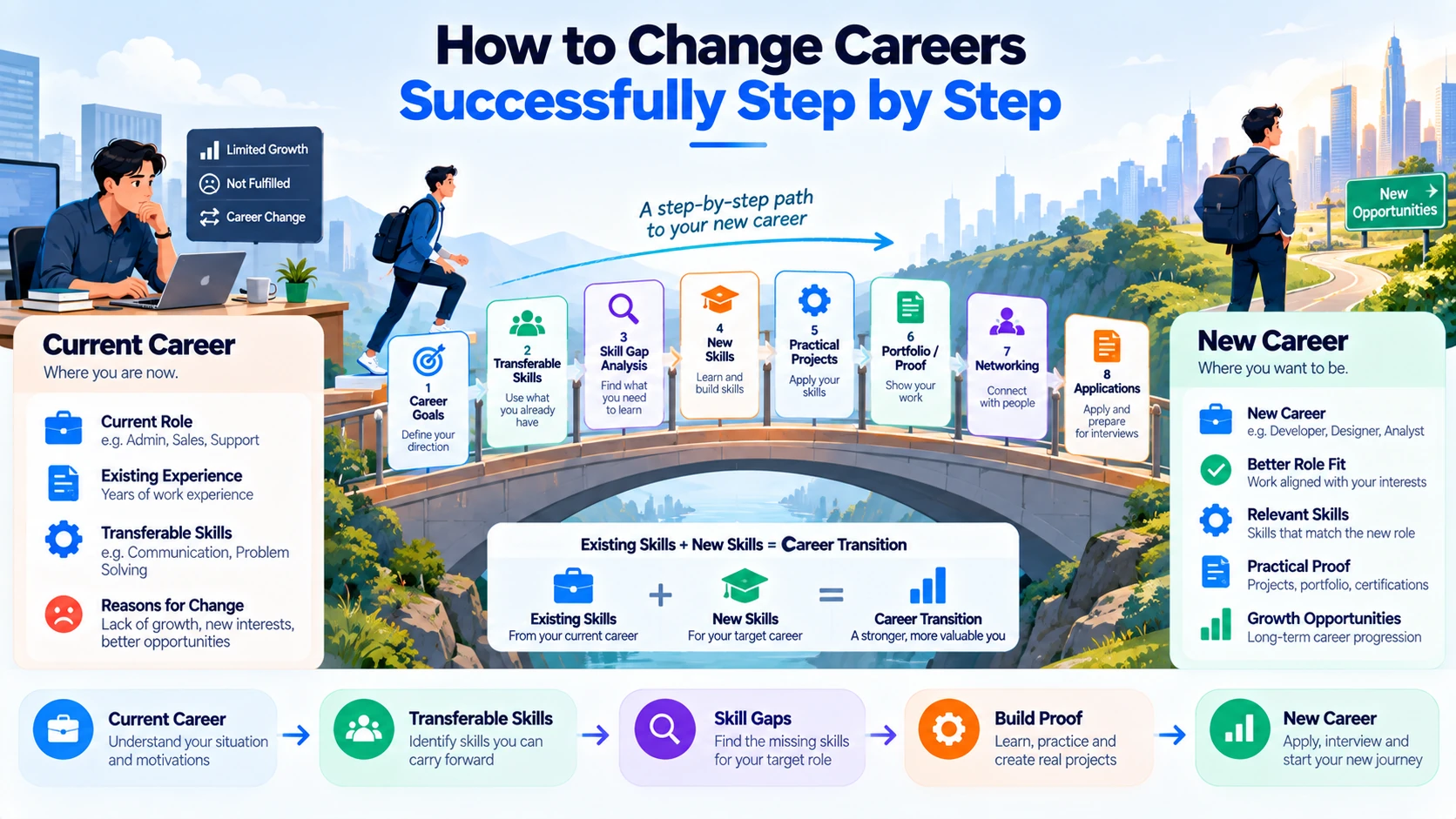
In many cases, you already have valuable skills that can move with you into a new field. A successful career change usually follows a structured path:
Reason → Target Career → Transferable Skills → Skill Gaps → Test → Proof → Transition
The goal is not to leave your current career as quickly as possible. The goal is to understand why you want to move, choose a realistic direction, build the missing skills, reduce risk, and transition with evidence.
Should You Change Careers?
Before deciding to change careers, first understand what is actually causing the problem. Sometimes the issue is not the career itself.
It may be:
- A Bad Manager
- Limited Growth
- Poor Company Culture
- Low Compensation
- Burnout
- Lack of Challenge
- Industry Decline
- Misalignment With Your Interests
| Situation | Better First Step |
| Bad Manager | Consider Another Team or Company |
| No Growth | Explore Promotion or Internal Mobility |
| Industry Declining | Career Change May Make Sense |
| Burnout | Recover Before Making a Major Decision |
| Strong Interest in Another Field | Research and Test It First |
Ask yourself:
- Is The Problem My Role or My Employer?
- Do I Still Enjoy Any Part of My Current Work?
- Would I Feel Better in the Same Role at Another Company?
- Is My Industry Still Attractive to Me?
- Am I Moving Toward Something Better or Only Escaping Something Bad?
Indeed’s career change guide recommends evaluating job satisfaction, reviewing your interests, researching alternatives, and planning the move before making a major transition.
Step 1 – Define Why You Want a Career Change
Your reason should be more specific than: “I want something different.”
A clearer reason might be: “I want a more technical role where I can focus on problem-solving and product development instead of mostly client-facing work.”
Ask yourself:
- What Do I Want to Leave Behind?
- What Do I Want More Of?
- What Do I Want Less Of?
- Which Parts of My Current Role Do I Still Enjoy?
- What Type of Work Gives Me Energy?
- What Kind of Problems Do I Like Solving?
Your broader career goals should guide the decision. If your reason is unclear, you may switch careers and discover the same problems again in a different role.
Step 2 – Choose a Realistic Target Career
Do not choose a new career only because it looks attractive from the outside. Research what the work actually involves.
Look at:
- Daily Responsibilities
- Required Skills
- Entry Requirements
- Common Job Titles
- Portfolio Expectations
- Typical Career Progression
- Work Environment
- Compensation Structure
- Industry Stability
It can be useful to compare two or three possible careers before choosing one.
| Factor | Career A | Career B | Career C |
| Interest | High | Medium | High |
| Transferable Skills | High | Low | Medium |
| Skill Gap | Medium | High | Medium |
| Entry Difficulty | Medium | High | Low |
| Long-Term Fit | High | Medium | Medium |
A realistic target usually combines:
- Strong Interest
- Useful Existing Skills
- Manageable Skill Gaps
- Clear Entry Path
- Good Long-Term Fit
Step 3 – Identify Your Transferable Skills
One of the biggest career-change mistakes is assuming that everything from your previous career becomes irrelevant. That is usually not true.
Transferable skills are abilities that remain useful across different jobs and industries.
Examples include:
- Communication
- Project Management
- Problem-Solving
- Research
- Data Analysis
- Leadership
- Customer Understanding
- Stakeholder Management
- Technical Documentation
- Debugging
- Planning
- Decision-Making
Coursera’s transferable skills guide describes transferable skills as capabilities you can carry from one role to another, including communication, problem-solving, and teamwork.
Example: QA Tester to Developer
A QA professional moving into development may already have:
- Debugging Skills
- API Knowledge
- Product Understanding
- Attention to Detail
- Technical Communication
- Problem-Solving Ability
The missing skills may include:
- Programming Fundamentals
- Git
- Framework Knowledge
- Application Architecture
- Portfolio Projects
This is why a career change does not always mean starting again from the beginning. You are often combining old strengths with new capabilities.
Step 4 – Perform a Skill Gap Analysis
Once the target role is clear, compare what the role requires with what you can already do. A skill gap analysis helps make this more structured.
| Skill | Current Level | Required Level | Gap | Priority |
| Programming | 1 | 3 | 2 | High |
| Git | 1 | 3 | 2 | High |
| Communication | 4 | 4 | 0 | None |
| APIs | 3 | 3 | 0 | None |
The goal is not to learn everything. Focus on the skills that block entry into the new role.
Ask:
- Which Skills Are Essential?
- Which Gaps Are Largest?
- Which Gaps Matter Most?
- Which Skills Can Be Learned Later?
- Which Existing Skills Already Reduce the Gap?
Step 5 – Test the New Career Before Quitting
Do not assume you will enjoy a career just because the idea sounds attractive. Try to experience the actual work first.
Low-risk ways to test a new career include:
- Building a Small Project
- Completing a Practical Assignment
- Taking an Internal Cross-Functional Task
- Doing Freelance Work
- Volunteering
- Shadowing Someone in the Role
- Joining a Relevant Community
- Contributing to an Open-Source Project
- Completing a Short Course With a Real Project
- Talking to People Already Doing the Job
Ask yourself: “Do I enjoy the actual work, or only the idea of the career?”
Harvard Business Review’s career-transition guidance emphasizes that career reinvention often requires exploration before the final direction becomes clear.
Step 6 – Build the Missing Skills
Once you know your main gaps, choose the right way to close them. Do not assume every gap needs a course.
| Gap Type | Best Development Method |
| Knowledge Gap | Course, Documentation, Reading |
| Practical Gap | Real Project |
| Tool Gap | Hands-On Repetition |
| Communication Gap | Real Meetings or Presentations |
| Portfolio Gap | Build Work Samples |
| Industry Gap | Research and Networking |
A structured career development plan can help turn these gaps into actions and milestones.
For example, if your biggest gap is programming, a plan could include:
- Learn Core Fundamentals
- Build One Small Application
- Practice Git
- Complete a Second Project
- Get Feedback
- Fix Weak Areas
- Document Progress
The goal is usable capability, not just course completion.
Step 7 – Build Proof, Not Just Knowledge
Employers need evidence that you can do the work.
Saying “I completed three courses” is weaker than “I built two working projects and documented how I solved the main technical problems.”
Useful proof can include:
- Portfolio Projects
- Case Studies
- GitHub Repositories
- Writing Samples
- Freelance Work
- Volunteer Work
- Internal Projects
- Certifications Where Relevant
- Documented Results
Proof reduces career-change risk for both you and the employer.
It shows that your interest in the new field has already turned into practical capability.
Step 8 – Rewrite Your CV for a Career Change
Do not use your old CV unchanged. Your new CV should make the transition clear.
Update:
- Professional Headline
- Summary
- Transferable Skills
- Relevant Projects
- Target-Role Keywords
- Relevant Achievements
- Skills Section
- Older Experience That Still Supports the New Role
Weak Version
QA Engineer with 5 years of testing experience.
Better Version
QA Engineer transitioning into software development with hands-on experience in APIs, debugging, automation, and application workflows.
Do not invent experience. The goal is to reframe genuine experience around the new direction.
Step 9 – Update LinkedIn and Professional Profiles
Your LinkedIn profile should support the same career story as your CV.
Review:
- Headline
- About Section
- Skills
- Projects
- Featured Work
- Recent Learning
- Target-Role Language
- Professional Activity
Your profile should show where you are going without pretending you already hold a role you have never done.
Step 10 – Build a Career-Change Network
Networking is especially useful during a career transition. But networking should not begin with: “Can you get me a job?”
A better approach is to learn from people already working in the field.
Ask questions like:
- What Does Your Day-to-Day Work Look Like?
- Which Skills Matter Most?
- What Do Beginners Usually Struggle With?
- What Makes a Strong Entry-Level Candidate?
- Which Projects Would Demonstrate Readiness?
- What Should Someone Avoid When Entering This Field?
You can build your network through:
- Professional Communities
- Industry Events
- Meetups
- Former Colleagues
- Online Groups
- Conferences
- Alumni Networks
Build relationships before asking for referrals.
Step 11 – Reduce Financial Risk Before the Move
A career change can temporarily affect income or stability.
Before leaving your current role, consider:
- Emergency Savings
- Training Costs
- Possible Salary Reduction
- Job-Search Duration
- Personal Expenses
- Insurance or Benefits
- Family Responsibilities
- Transition Timeline
There is no single financial buffer that works for everyone.
Build enough flexibility for your personal situation and the likely transition period.
Where possible, test and prepare for the new career while still employed. That reduces pressure.
Step 12 – Start Applying Before You Feel 100% Ready
Career changers often wait too long. You do not need to meet every requirement before applying.
You may be ready when:
- Core Skills Are Present
- Major Gaps Are Manageable
- You Have Some Practical Proof
- Your CV Is Aligned
- You Can Explain the Transition Clearly
- You Understand the Target Role
Job descriptions often include a mix of essential and preferred requirements, so focus first on the capabilities that appear consistently across similar roles.
How to Explain a Career Change in an Interview
Your explanation should be positive and structured.
Past → Reason → Transferable Skills → Preparation → Target
Example:
My background is in QA, where I developed strong debugging, API, and product-analysis skills. Over time, I became more interested in development and started building my programming skills through practical projects. I’m now looking to move into a junior development role where I can combine my product knowledge with hands-on coding.
This works because it:
- Explains the Past
- Shows a Logical Transition
- Highlights Transferable Skills
- Shows Preparation
- Connects to the New Role
Avoid criticizing your previous employer.
Career Change Without Experience
Many people say: “I cannot change careers because I have no experience.”
But “no experience” may simply mean you have no formal title in the new field.
You may still have:
- Transferable Skills
- Adjacent Experience
- Practical Projects
- Domain Knowledge
- Freelance Work
- Volunteer Work
- Internal Exposure
- Relevant Tools
The goal is to create bridge experience.
Personal projects and volunteer work can demonstrate capability, but they should not be presented as formal employment experience.
For example, someone moving from marketing to data analytics might analyze campaign data and turn that work into a portfolio case study. Someone moving from QA to development might build applications that demonstrate coding skills.
Career Change at 30, 40, or Later
A career change does not automatically become impossible because of age.
Later-career professionals may already have advantages such as:
- Industry Knowledge
- Professional Networks
- Communication Skills
- Leadership Experience
- Business Understanding
- Stronger Work Habits
The practical difficulty of a career change depends more on financial responsibilities, skill gaps, and target-role requirements than on age alone.
A staged transition may be more realistic than an immediate one.
- Keep Current Job
- Learn Core Skills
- Build Projects
- Network
- Test Target Career
- Apply Gradually
- Transition When Opportunity Is Strong
90-Day Career Change Plan
Days 1-30
- Define the Target Career
- Research Relevant Roles
- Identify Transferable Skills
- Perform a Skill Gap Analysis
- Choose High-Priority Gaps
- Speak With People in the Field
Days 31-60
- Learn Core Missing Skills
- Build One Practical Project
- Get Feedback
- Update CV
- Update LinkedIn
- Join Relevant Communities
Days 61-90
- Finish the Main Project
- Add Work to Portfolio
- Practice Interview Explanations
- Start Selective Applications
- Track Interview Feedback
- Adjust Skill Gaps
A 90-day plan does not guarantee a complete transition. It gives you enough structure to test whether the path is realistic.
Career Change Example – QA Tester to Junior Developer
Current Role
QA Tester
Target Role
Junior Developer
Transferable Skills
- Debugging
- API Testing
- Technical Communication
- Product Knowledge
- Problem-Solving
- Application Workflows
Main Gaps
- Programming Fundamentals
- Git
- Framework Basics
- Application Architecture
Development Plan
- Strengthen Programming Fundamentals
- Learn Git
- Build Two Small Applications
- Practice Working With APIs
- Study Basic Application Architecture
Proof Plan
- Publish Projects on GitHub
- Write Clear Project Documentation
- Get Code Feedback
- Take an Internal Coding Task Where Possible
Transition Plan
- Update CV
- Update LinkedIn
- Target Junior or Associate Roles
- Explain QA Experience as a Strength
- Continue Building Development Proof
A structured WordPress developer roadmap, for example, could help someone targeting WordPress development understand which skills should be built in sequence.
Common Career Change Mistakes
Quitting Before Researching: Do not leave first and investigate later unless your circumstances require it. Research the target career before making a major move.
Changing Careers Because of One Bad Manager: A company change may solve the problem without requiring a complete career transition.
Ignoring Transferable Skills: Your previous career is not wasted experience. Identify what still creates value.
Learning Forever Without Building Proof: Courses can become a form of procrastination. Build something.
Choosing a Career Only for Salary: Compensation matters, but long-term fit matters too.
Copying Job Descriptions Blindly: Look across multiple roles to identify the skills that consistently matter.
Hiding Your Previous Career: Your previous experience can strengthen your story when positioned correctly.
Exaggerating Experience: Never present learning or personal projects as employment experience.
Waiting Until You Feel 100% Ready: Complete readiness is unrealistic. Apply when you can demonstrate the core capability.
Applying Everywhere Without a Target: A focused transition is easier to explain than a random one.
Ignoring Financial Risk: Plan how the transition could affect your income and expenses.
Career Change Checklist
- Reason for the Change Is Clear
- Target Career Is Selected
- Target Role Has Been Researched
- Transferable Skills Are Identified
- Skill Gaps Are Documented
- Priority Skills Are Selected
- New Career Has Been Tested
- Practical Proof Has Been Built
- CV Has Been Updated
- LinkedIn Has Been Updated
- Professional Network Is Growing
- Financial Risk Has Been Considered
- Applications Have Started
- Interview Story Is Prepared
How Career Change Fits Into Your Career Growth Plan
Career Goals → Skill Gap Analysis → Career Development Plan → Career Change
Your career goals help define the new direction. Your skill gap analysis shows what capability is missing. Your career development plan turns those gaps into actions. The career change is the stage where you use that preparation to move into the new role.
Frequently Asked Questions
How Do I Know If I Should Change Careers?
Start by identifying whether your dissatisfaction comes from your role, employer, manager, industry, compensation, or long-term interests. A full career change makes more sense when the problem is connected to the career itself rather than one temporary workplace issue.
How Do I Make a Career Change Successfully?
Choose a clear target role, identify transferable skills, analyze your skill gaps, test the new career, build practical proof, update your professional profile, and transition gradually where possible.
Can I Change Careers Without Experience?
Yes, but you need another form of evidence. Transferable skills, projects, freelance work, volunteer experience, internal tasks, and relevant domain knowledge can help demonstrate readiness.
How Do I Identify Transferable Skills?
Review your current responsibilities and ask which capabilities would still create value in another role. Communication, leadership, project management, analysis, problem-solving, technical knowledge, and customer understanding are common examples.
Should I Quit My Job Before Changing Careers?
Not necessarily. Keeping your current role while researching, learning, testing the new field, and applying can reduce financial pressure.
How Long Does a Career Change Take?
There is no universal timeline. The transition depends on the size of your skill gaps, the target field, available opportunities, financial situation, and how much relevant experience you already have.
Is It Too Late to Change Careers at 30 or 40?
Age alone does not determine whether a career change is realistic. Existing experience, transferable skills, financial responsibilities, and the size of the transition are more useful factors to consider.
How Do I Explain a Career Change in an Interview?
Explain your previous background, why the new direction makes sense, which transferable skills support the move, what you have done to prepare, and why the target role fits your goals.
Final Thoughts
A successful career change is usually not one dramatic decision. It is a sequence of smaller decisions.
Understand why you want to move. Choose a realistic target. Identify what you already bring with you. Find the important gaps. Test the new career before making unnecessary risks. Build practical proof. Then move into the market with a clear story.
The strongest career transitions do not erase your previous experience. They use it as a foundation for the next stage of your career.
