
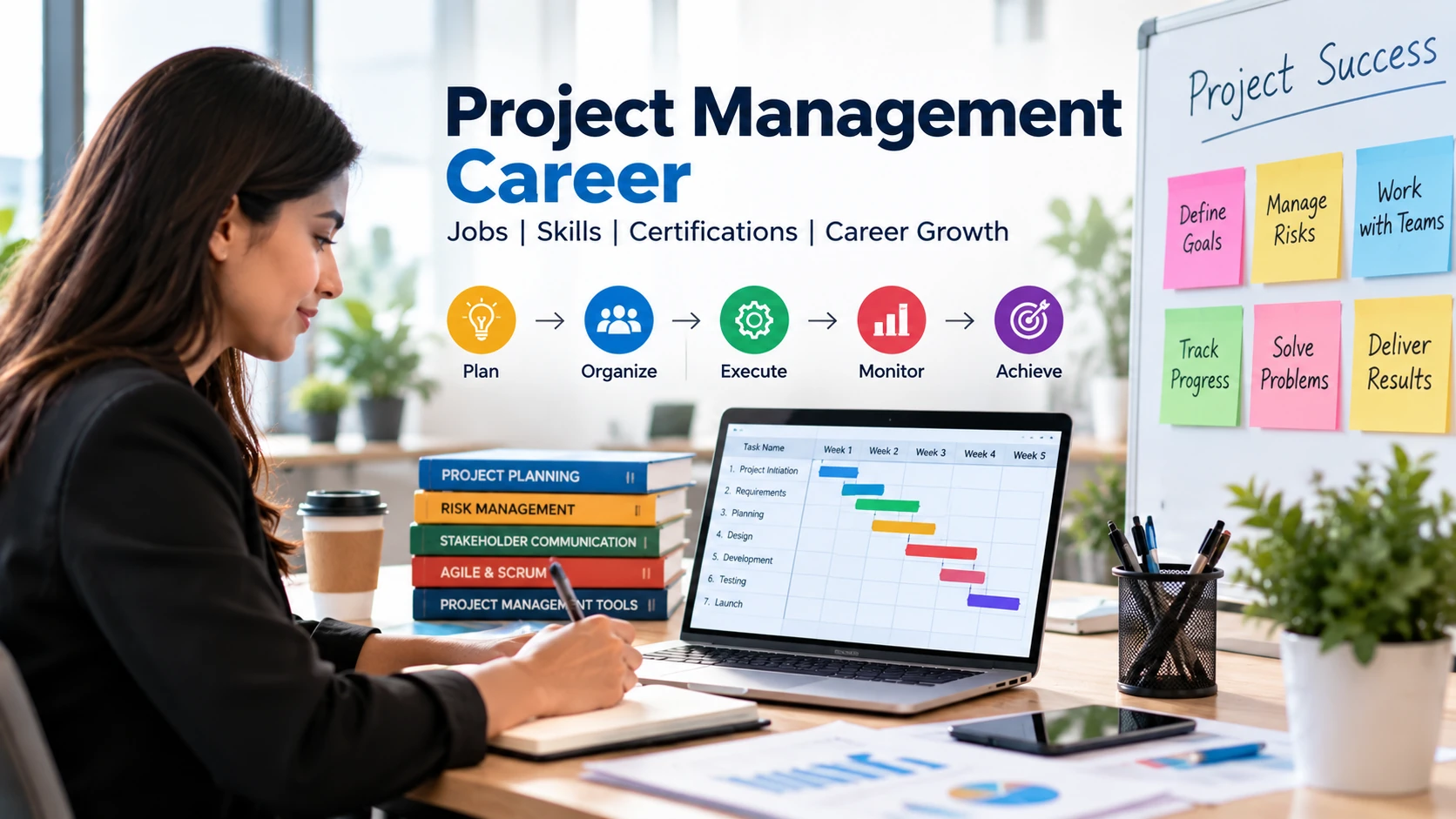
A project management career is not reserved for people who already hold a project manager title. Coordinating a product launch, organizing an event, or helping a team deliver a website can develop relevant skills. The challenge for a beginner is proving those skills without exaggerating their experience.
Start by learning how projects are defined, planned, delivered, and reviewed. Then complete a small, documented project, identify roles that suit your background, and decide whether training or certification addresses a genuine gap. This guide covers career paths, practical exercises, qualifications, and job applications for readers in different countries. Building a project management career also requires practical evidence that you can plan, coordinate, communicate, and manage project work.
Pasted markdown
What Is a Project Management Career?
Project management means applying knowledge, skills, tools, and techniques to meet a project’s requirements, according to the Project Management Institute (PMI). A project has a defined outcome and is different from ongoing operations such as answering routine customer inquiries. Projects appear in technology, construction, healthcare, education, and other industries.
The work involves balancing scope, time, cost, quality, resources, and stakeholder expectations. A website launch needs agreed features, a schedule, specialists, testing, and approval. The project manager coordinates that work.
What Does a Project Manager Do?
Typical activities include agreeing objectives, identifying deliverables, estimating work, assigning responsibilities, tracking progress, managing risks, resolving blockers, and updating stakeholders. They also assess the impact of change requests. The exact balance of responsibilities differs by employer and industry. An IT project manager may coordinate software releases, whereas a construction project manager works with site teams, contractors, safety requirements, and physical schedules.
Project Management Career Paths and Job Roles
There is no universal ladder. Someone may enter through administration, engineering, operations, business analysis, or software delivery. Job titles also vary, so compare actual responsibilities rather than assuming identical titles mean identical work.
| Career stage | Example role | Typical contribution |
| Supporting | Project assistant or administrator | Maintains documents and meeting records |
| Coordinating | Project coordinator | Tracks tasks, deadlines, and dependencies |
| Managing | Project manager | Owns planning, delivery coordination, and reporting |
| Advanced | Senior project manager | Handles larger or more complex initiatives |
| Wider scope | Program manager | Coordinates related projects toward broader outcomes |
Entry-Level Project Management Roles
Project assistant, project administrator, project support officer, and project coordinator are useful search terms. Some junior project manager jobs also accept applicants who have supported delivery but have not held the title. Read the essential requirements carefully; an advertised entry-level role may still require industry knowledge.
IT vs Construction vs Business Project Management
In IT, the work might involve developers, testers, releases, and changing requirements. Construction projects typically involve physical works, procurement, contractors, permits, and safety. Business projects may focus on process improvements, office moves, or system implementations. Sector-specific requirements still differ.
Career Progression and Senior Roles
A possible route is coordinator to project manager to senior project manager. Other directions include program management, portfolio management, delivery management, or a specialist role. Promotion is not automatic.
Essential Project Management Skills for Beginners
Start with skills you can demonstrate in a modest project. You do not need to master every methodology or enterprise platform before applying for support roles.
Technical and Planning Skills
Learn to define scope, identify deliverables, break work into manageable tasks, estimate durations, map dependencies, assign owners, maintain a risk register, and report status. Basic spreadsheets can handle many beginner exercises. Distinguish assumptions, risks, issues, and change requests.
Communication and Leadership Skills
A useful status update explains what is complete, what is next, what is blocked, and what decision is needed. Listening, negotiation, documentation, and calmly escalating problems matter as much as a polished schedule. Leadership means clarifying responsibilities and helping the team collaborate.
Do You Need a Degree to Become a Project Manager?
Requirements vary by role and country. The US Bureau of Labor Statistics says project management specialists typically need a bachelor’s degree; it does not say every project-support vacancy requires one. Some employers value sector-specific education, while others consider transferable experience and suitable training. Check requirements for specific vacancies.
How to Start a Project Management Career: Step-by-Step Roadmap
Use the following stages as a learning sequence, not a promised timeline. Each ends with something tangible that you can show or discuss in an interview. This roadmap gives beginners a practical way to build a project management career through learning, practice, and documented work.
Step 1 — Learn Project Management Fundamentals
Choose a small outcome, such as launching a five-page website. Write a one-sentence objective, identify the customer, list what is included and excluded, and define what completion means. Learn the terms scope, milestone, dependency, stakeholder, risk, and deliverable.
Deliverable: A one-page project charter containing the objective, scope, success criteria, and key stakeholders.
Step 2 — Understand Agile, Scrum and Traditional Methods
Study when a team can plan work up front and when requirements may change. Learn the basic difference between predictive, adaptive, and hybrid approaches. Scrum is a specific framework, not a synonym for every Agile practice; read the official Scrum Guide for its accountabilities, events, and artifacts.
Deliverable: A short explanation of which approach you would use for the website example and why.
Step 3 — Practice Planning and Managing a Project
Break the website launch into discovery, design, development, testing, approval, and release. Assign an owner and expected completion date to each task. Identify dependencies: testing cannot fully finish before the relevant feature exists. Record risks such as delayed content or unavailable reviewers. Document how an added page affects the schedule. For each change, record its requester, likely impact, approver, and final decision.
Deliverable: A task plan, dependency list, risk register, and change log. Label any invented dates or outcomes as examples.
Step 4 — Learn Project Management Tools
Build your plan in a spreadsheet first, then reproduce it in a task-tracking application. Learn how to create tasks, assign owners, update status, and report overdue work. Sample data is enough to demonstrate the process.
Deliverable: A working project board and a one-page weekly status update.
Step 5 — Build Your Portfolio and Apply for Jobs
Combine your charter, plan, risks, decisions, and final review into one case study. Explain what you assumed, why you chose your approach, and what you would measure during a real project. Discuss your decisions in interviews and target suitable roles.
Deliverable: An honest portfolio case study and a resume tailored to a specific opening.
How to Gain Project Management Experience Without a Job
Professional experience and practice are not the same thing. A hypothetical portfolio shows how you think; an authorized volunteer or workplace project can also show what you actually did. Do not imply a simulation meets experience requirements for a certification or employer.
Create a Sample Project
Use a fictional website launch for a local bookstore. Its objective is to publish five pages and a contact form. Define an assumed four-week schedule, then map work to a designer, developer, tester, and owner.
For example, enter “Product descriptions arrive late” in the risk register. Set its likelihood to medium, record a possible delay to review, assign the store owner, and plan to request copy before development finishes. These are illustrative judgments, not measured risk scores.
Build a Project Management Portfolio
Prepare a concise case study with the problem, scope, plan, task board, risks, change decisions, and retrospective. Explain that no real customer, budget, or delivery result exists if the project was simulated. Describe the plan, not fictional delivery results.
Use Volunteer or Existing Work Experience
You may already coordinate work in customer support, operations, education, or community activities. With permission, help schedule a real event, track an internal improvement, or organize a small team initiative. Record your own contribution and get permission before sharing materials.
If you have coordinated a real project, add a separate case study describing your actual responsibilities and verifiable results. Otherwise, present the sample project honestly as practice.
Project Management Methodologies Explained
Methodologies describe how teams organize delivery. Pick an approach that fits the work and the team’s constraints rather than claiming that one method always produces better results. PMI distinguishes predictive, adaptive, and hybrid approaches.
Predictive Project Management
Predictive planning suits work with relatively stable requirements and defined stages. The team establishes a baseline plan, controls changes, and monitors execution against it. For example, an office relocation may have a fixed move date and procurement dependencies, although unexpected issues can still arise.
Agile and Scrum
Adaptive approaches accommodate uncertainty through short feedback cycles and revised plans. Scrum is one framework for complex work, with specific accountabilities and a product backlog. A project manager is not automatically a Scrum Master, and a task board alone does not make a team Scrum-based.
Hybrid Project Management
Hybrid approaches combine predictive and adaptive elements. A website launch might retain a fixed approval deadline while refining individual features through frequent feedback.
Project Management Certifications: CAPM, PMP and Google
Choose training based on eligibility, budget, the roles you are applying for, and whether you need introductory learning or recognition of existing experience. Check official eligibility and fees before paying.
CAPM Certification for Beginners
PMI’s Certified Associate in Project Management (CAPM) is designed for foundational project-management knowledge and does not require prior project experience. Its published eligibility includes a secondary degree or equivalent and at least 23 hours of project management education before the exam.
PMP Certification for Experienced Professionals
The Project Management Professional (PMP) requires qualifying project-leadership experience and training; eligibility depends on your education. PMI revised the exam in July 2026 and announced changes to eligible live training starting December 1, 2026. Review its current exam and training guidance before buying preparation materials. Completing an introductory course alone does not establish PMP eligibility.
Google Project Management Certificate
The Google Project Management Professional Certificate on Coursera is beginner-oriented and states that no prior degree or experience is required to enroll. It offers structured coursework and practical exercises. Enrollment messaging and the cost of earning the credential are not identical: Coursera lists a monthly subscription after its free trial for the US and Canada, with regional prices potentially differing. It is distinct from CAPM and PMP.
| Credential | What to check before enrolling |
| CAPM | Secondary education, training hours, exam fees, and eligibility |
| PMP | Qualifying leadership experience, training, and current exam rules |
| Google certificate | Curriculum, subscription terms, and relevance to target jobs |
Project Management Tools Beginners Should Learn
A spreadsheet is sufficient for learning task ownership, dates, risks, and status reporting. Trello or Asana can turn tasks into a visual board. Jira is commonly encountered in software delivery, while Microsoft Project offers scheduling capabilities for more structured planning. Availability, plans, and features vary; review official product documentation before making a purchase.
For a software launch, a project manager may coordinate with testers who use bug-tracking and test-management platforms. Our guide to software testing tools explains the QA tools involved in that adjacent workflow; it is not a substitute for learning project planning itself.
Compare two tools for dependencies, reporting, and complexity.
How to Find Your First Project Management Job
Start with responsibilities, not prestige. Hiring requirements vary across industries and regions.
Entry-Level Job Titles to Search For
Search for project coordinator, project administrator, project assistant, PMO assistant, project support officer, and junior project manager. In tech, delivery coordinator or implementation coordinator may also be relevant. Read requirements for software knowledge, procurement, scheduling, client communication, and experience before deciding whether to apply.
Resume and Interview Preparation
Match each resume bullet to evidence. If you coordinated a genuine university event, describe the schedule, people involved, and your own role. For a simulated website plan, write “Created a sample project charter, risk register, task schedule, and change log” rather than inventing client results.
Prepare to answer: How would you respond to a missed deadline? Who approves a scope change? What would you tell a stakeholder about a blocker? Use your case study to explain a decision, the information available, and the next action. Protect confidential documents.
Remote Jobs and International Opportunities
Use employer career pages and established job boards for your target country. Readers in the US, UK, Canada, Australia, UAE, Pakistan, and India should check the employer’s actual location and eligibility rules; an online listing does not automatically permit applications from every country. Remote roles may specify time zones, work authorization, employment arrangements, or required local experience.
Compare equivalent roles within each local market.
Project Management Salary and Career Growth
Pay depends on country, industry, job level, project complexity, and whether the role involves staff or budget responsibility. An entry-level coordinator and an experienced construction project manager are not interchangeable salary benchmarks.
The US Bureau of Labor Statistics reports a May 2025 median annual wage of $102,320 for US project management specialists. That occupational median includes workers at different experience levels; it is neither an entry-level offer nor a worldwide project-manager salary. Consult dated, comparable local salary information for other countries.
What Influences Project Manager Salaries?
When assessing an offer, compare the job’s scope, industry, location, hours, benefits, and progression expectations. Career growth may involve managing more complex projects, specializing in a sector, or coordinating programs.
How AI Is Changing Project Management Work
AI-assisted tools can help draft meeting summaries, organize tasks, identify possible dependencies, and prepare reporting templates. They can also invent decisions, miss context, or expose sensitive information if used carelessly. Confirm meeting outcomes with participants, validate schedules against real constraints, and follow organizational data policies before uploading project material.
Frequently Asked Questions
Can I Become a Project Manager Without Experience?
You can start learning and apply for some project-support opportunities without having held the project manager title. Some vacancies require related experience, so build an honest portfolio and look for coordination responsibilities in existing work or volunteering.
Do I Need a Degree for Project Management?
It depends on the occupation and employer. The US BLS says a bachelor’s degree is typical for project management specialists, while specific coordinator roles may have different criteria. Review job postings in your own market.
How Long Does It Take to Become a Project Manager?
There is no reliable universal timeline. Your background, opportunities to coordinate real work, industry requirements, and training all matter. Judge progress by demonstrable skills and responsibilities rather than a promised number of weeks.
Should I Get CAPM or PMP First?
Check eligibility before choosing. CAPM offers a foundational route without prior project experience, subject to education requirements. PMP requires qualifying project leadership experience. A structured beginner course may be useful even if you do not pursue either exam immediately.
Your Next Step Toward a Project Management Career
Choose a small project and document its objective, scope, tasks, risks, and decisions. Turn the work into a truthful case study, then compare it with entry-level job requirements in your target market. That gives you specific skills to improve and evidence to discuss, without relying on unsupported promises about hiring or salaries. These steps can help you build a project management career based on demonstrable skills and relevant experience.
