
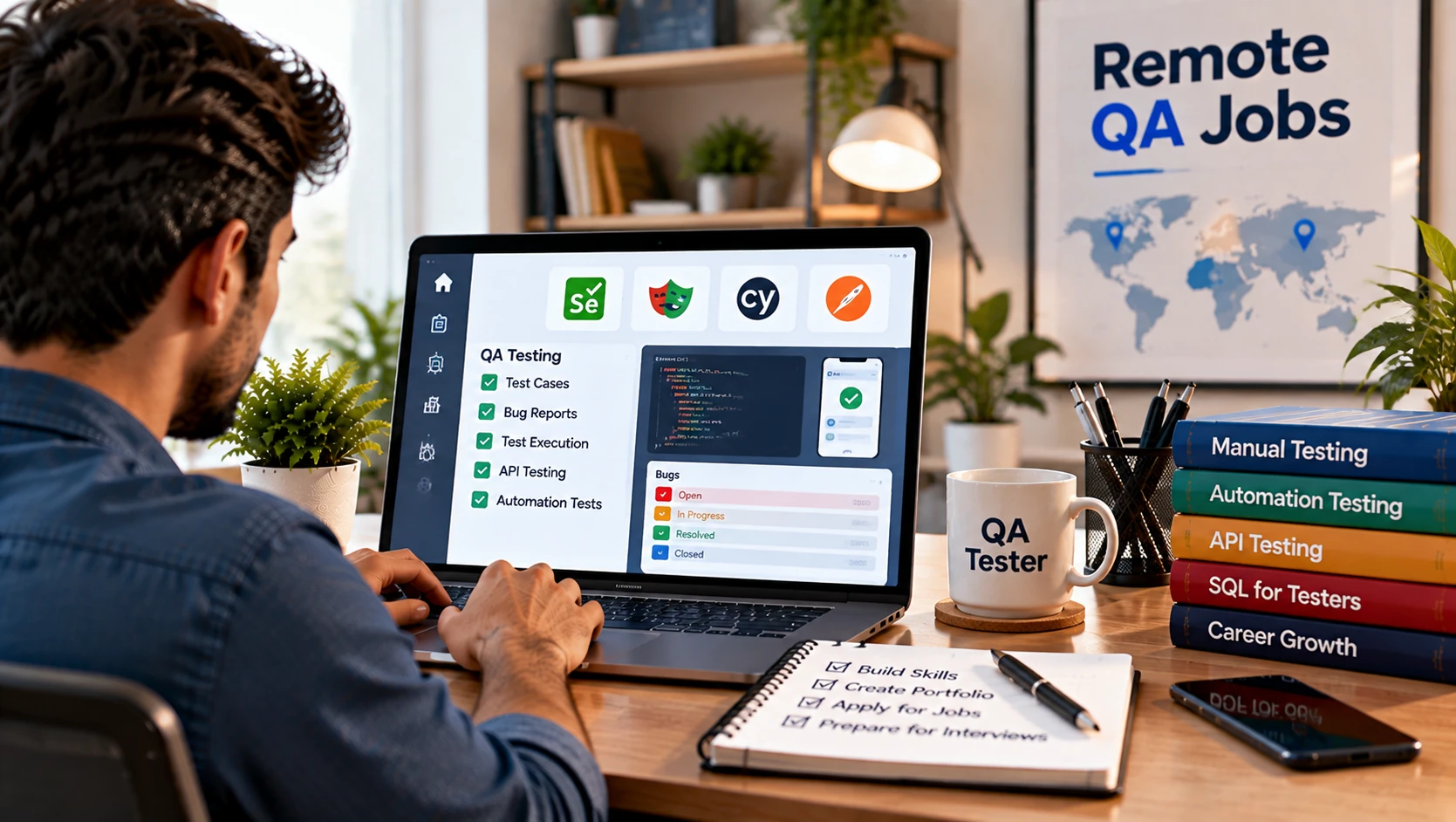
Remote SQA jobs require more than learning how to test software. You also need to understand which roles match your current skills, how to prove those skills, whether a remote vacancy accepts applicants from your country, and how to present yourself clearly during applications and interviews. You also need to know which roles match your current skills, how to prove those skills, whether a remote vacancy actually accepts applicants from your country, and how to present yourself clearly during applications and interviews.
For beginners, the word “remote” can be misleading. A job may be fully remote but limited to one country, a group of countries, or a required time-zone overlap. Some roles focus on manual testing, while others expect API testing, SQL, automation, or programming.
This guide explains the main remote QA roles, the skills employers may ask for, how to build an honest portfolio, where to look for legitimate opportunities, how to screen location eligibility, how to tailor your CV and application, and how to evaluate compensation and job offers without relying on unrealistic guarantees.
What Is a Remote SQA Job, and Can Beginners Apply?
Beginners exploring remote SQA jobs should understand the role expectations, required skills, and proof of ability before applying. The work can include reviewing requirements, designing tests, executing checks, reporting defects, verifying fixes, and communicating risks to developers, product managers, and other stakeholders.
What Does a Remote SQA Engineer Do?
A remote QA engineer may test web applications, mobile apps, APIs, integrations, or internal systems. Work can include functional and exploratory testing, regression checks, writing test cases, reproducing issues, validating fixes, and documenting results. In distributed teams, written communication must also be clear for colleagues who may not be online at the same time.
Remote QA vs Remote SQA: Is There a Difference?
QA means Quality Assurance, while SQA means Software Quality Assurance. Employers may use titles such as QA Engineer, Software QA Engineer, QA Analyst, Test Engineer, or Software Tester for overlapping responsibilities.
Do not assume two similar titles describe the same role. Always read the responsibilities, technical requirements, seniority, employment type, and location rules in the vacancy.
Do Remote SQA Jobs Require Previous Experience?
Requirements vary. Some junior roles may consider internships, coursework, or personal projects, while mid-level and senior positions generally expect stronger professional experience. Beginners should focus on jobs where they can demonstrate most essential requirements. If you are still building the fundamentals, use CareerTechGuide’s software testing career guide before specializing in remote applications.
Types of Remote QA Jobs You Can Explore
Remote QA jobs vary significantly in technical depth. The following categories are useful for understanding the market, but employers may combine responsibilities. The variety of remote QA jobs means candidates can choose a path based on their current skills, such as manual testing, automation, API testing, or SDET roles.
Remote Manual SQA Tester
Manual SQA testers check whether software behaves as expected through planned and exploratory testing. Typical tasks include preparing scenarios, executing functional checks, performing regression testing, and documenting defects.
For a beginner, useful evidence includes clear test cases, execution results, and reproducible bug reports.
Remote Automation SQA Engineer
Automation SQA engineers build repeatable checks using code and frameworks such as Playwright, Selenium, or Cypress. Good automation work requires assertions, test design, debugging, test data management, and maintenance.
Remote API Tester
API testing focuses on communication between systems. A tester may validate HTTP methods, status codes, response bodies, authentication, error handling, and business rules.
Tools such as Postman are useful for learning and exploration. Basic SQL can also help when a role requires comparing API behavior with stored data.
Remote SDET
An SDET, or Software Development Engineer in Test, combines programming with quality engineering. The role may include framework design, automated checks, and integration with engineering workflows. It is normally more technical than beginner manual testing.
| Role | Typical work | Useful portfolio evidence |
| Manual QA | Functional and exploratory testing | Test cases and defect reports |
| Automation QA | Repeatable automated checks | Test repository |
| API tester | API and integration validation | API collection and assertions |
| SDET | Test engineering and framework work | Structured automation project |
Skills You Need for Remote SQA Jobs
The right skill set depends on your target role. A beginner does not need every testing technology at once.
Manual Testing and Defect Reporting
Start with requirements analysis, test-case design, exploratory and regression testing, and defect reporting. A useful defect report includes the environment, reproduction steps, expected behavior, actual behavior, and relevant evidence.
API Testing and Basic SQL
Learn requests, responses, assertions, HTTP methods, status codes, headers, authentication, and JSON. For SQL, beginner knowledge can include SELECT statements, filters, sorting, and basic joins. Do not present sample-data practice as production experience.
Automation for Relevant Roles
Choose one framework that fits your target jobs. Practice structuring tests, writing reliable assertions, handling test data, and investigating failures. For tool comparisons, see CareerTechGuide’s software testing tools guide.
Remote Communication and Documentation
Practice concise status updates, defect summaries, completion notes, and handovers. If a requirement is unclear, document the question rather than guessing.
Git and CI/CD Awareness
Some roles expect Git, pull requests, issue trackers, or CI. These are role-dependent rather than universal beginner requirements.
How to Build a Remote QA Portfolio Without Professional Experience
A portfolio should demonstrate real work without presenting a practice project as paid experience.
Select a System You Are Authorized to Test
Use an application you created, an explicitly permitted demo environment, or another system you are authorized to test. Do not probe random production websites for weaknesses without permission.
Write Meaningful Test Cases
Create test cases around specific behavior. For example, verify that checkout blocks submission when a required email field is empty. Record the actual result only after execution; a test idea is not an observed defect.
Document Defects Without Inventing Them
Do not add fake defects to make your portfolio look bigger. If a feature works correctly, record the test as passed. When you observe a real issue, document the exact steps, environment, evidence, and reproducibility.
Add API Testing or Automation Evidence
For API work, include requests and assertions. For automation, create a small suite around a stable workflow. Add instructions so another person can understand and run the project.
Publish a Clear Project Summary
Explain the scope, environment, approach, findings, and limitations. A concise README is more useful than unexplained screenshots.
Portfolio Case Study: Demo E-Commerce Checkout QA Project
This is an original personal-practice example, not a client project.
Objective: Evaluate a simulated e-commerce checkout flow.
Scope: Cart changes, required fields, invalid input, shipping details, and confirmation behavior.
Deliverables: Test cases, execution results, genuine defect reports if issues are observed, plus optional API or browser automation checks.
Add a short handover such as: “Checkout testing is complete for the agreed scope. Required-field validation passed. One confirmation-flow issue remains under investigation; reproduction steps and environment details are in the defect report.”
Label the work Personal Practice Project so testing evidence is not confused with employment.
Where to Find Legitimate Remote QA Jobs
Job platforms are useful for discovery, but they should not replace employer verification.
LinkedIn Jobs and Employer Career Pages
Use LinkedIn Jobs to search QA Engineer, Software Tester, QA Analyst, Automation Engineer, and SDET roles. Apply remote and experience filters, then verify the employer through its official website or careers page.
Remote-Focused Job Boards
Remote.co’s QA jobs page is a useful starting point; current listings show that some fully remote roles remain country-restricted. We Work Remotely separately labels some jobs “Anywhere in the World” and others by specific countries or regions. Always review the individual posting.
Freelance Platforms
Upwork can be used to discover project-based work. Freelancing differs from salaried employment and may not include benefits or long-term continuity. Check scope, payment terms, platform rules, and testing authorization.
Search Terms and Job Tracking
Useful searches include remote QA jobs, remote software tester, manual QA remote, automation QA remote, remote SDET, and API tester remote. Track the employer, vacancy URL, location eligibility, time-zone requirement, experience level, and application status.
Worldwide vs Country-Restricted Remote Eligibility
One of the biggest mistakes in remote job searching is treating “remote” as a synonym for “work from anywhere.”
Fully Remote Does Not Always Mean Worldwide
A vacancy can be fully remote yet restricted to one country or region. Look for phrases such as “US only,” “EU applicants,” “remote within Canada,” or a list of approved countries. Remote.co currently shows 100% remote listings marked “Remote, US National,” while We Work Remotely labels some positions “Anywhere in the World.” The location field therefore matters as much as the word remote.
How to Check Eligibility From Pakistan or India
Before applying, check eligible countries, employee or contractor status, residency or work-authorization requirements, and time-zone overlap. If a vacancy says “Remote – United States only,” a candidate in Pakistan should not treat it as worldwide remote.
Time-Zone Overlap
If a vacancy requires four hours of overlap with 09:00-17:00 UTC, you need four available hours inside that window. For local zones such as US Eastern Time, account for daylight-saving changes rather than assuming one fixed year-round offset.
Employee vs Contractor Arrangements
A contractor arrangement can change taxes, benefits, leave, insurance, invoicing, equipment responsibilities, and notice terms. Compare the complete arrangement, not only the headline pay.
How to Tailor Your CV for Remote QA Roles
A remote QA CV should demonstrate testing ability and reliable communication.
Match the Vacancy
If the job emphasizes API testing, highlight genuine API work; if it focuses on manual regression, prioritize test design, execution, and defect reporting. Do not add tools you have not used.
Show Remote-Work Evidence Honestly
Where true, mention documentation, issue tracking, GitHub, Jira, Slack, Teams, or written handovers. A project entry could say: “Designed and executed checkout test cases, documented results, created API checks, and maintained project documentation in GitHub.” For general structure, see CareerTechGuide’s tech CV for Gulf jobs guide, while remembering that conventions vary by market.
How to Apply for Remote QA Jobs
Step 1: Shortlist Suitable Vacancies
Check technical requirements, seniority, eligible countries, time-zone expectations, and employment type first.
Step 2: Match Requirements With Evidence
Match each important requirement with evidence from work, internships, coursework, or a labelled portfolio project. Treat unsupported requirements as real gaps.
Step 3: Customize Your Application
A concise application might say: “I am applying for the Junior Remote QA role. My QA portfolio includes functional checkout testing, defect reporting, and API validation. I have included the project documentation and repository for review.” Adapt it to your actual experience.
Step 4: Submit Through a Verified Channel
Prefer an official careers page or recognized job platform. Avoid sending banking details or sensitive documents before verifying the employer.
Step 5: Track and Improve
Track dates, responses, and recurring skill gaps. A fixed number of applications does not guarantee interviews.
How to Prepare for Remote QA Interviews
Technical Questions
You may be asked to test a login page, checkout form, mobile app, or API. Explain assumptions, priorities, positive and negative cases, risks, and evidence.
Portfolio Walkthrough
Be ready to explain the project scope, case selection, defect reporting, limitations, and what you would test next.
Remote Communication
Practice a short bug summary and testing status update; clear communication is essential in distributed teams.
Take-Home Tasks
Test only what the employer authorizes. Document coverage and limitations, and do not expand a take-home task into unauthorized security testing.
Remote QA Salaries: How to Research Compensation Carefully
There is no reliable worldwide beginner salary for remote QA jobs. Location, experience, role, contract type, currency, and benefits all matter.
Use Salary Benchmarks in Context
The U.S. Bureau of Labor Statistics reports a May 2025 median annual wage of $104,300 for software quality assurance analysts and testers. It is a U.S. occupational median across experience levels, not a worldwide remote or beginner salary. Use the BLS occupational page only as a qualified U.S. benchmark.
Compare Like With Like
When a vacancy publishes pay, check geography, currency, seniority, employment type, benefits, and required hours. Contractor rates are not directly comparable with employee salaries because costs and benefits differ.
How to Verify a Remote QA Job Offer
Remote-job scams can imitate legitimate employers, so verification should happen before you send money or sensitive information.
Confirm the Employer
Visit the organization’s official website and careers page, check recruiter contact details, and independently research suspicious offers.
Never Pay for the Promise of a Job
The U.S. Federal Trade Commission warns that work-from-home scams may demand payment for training or equipment or use fake checks. See the FTC’s work-from-home job scam guidance for examples and precautions.
Review the Written Terms
Before accepting, confirm the legal employer or client, responsibilities, compensation, currency, payment schedule, hours, contract duration, notice terms, benefits, and equipment arrangements. Cross-border tax and legal obligations depend on the countries involved, so verify rules that apply to you.
Frequently Asked Questions
Can Beginners Get Remote QA Jobs Without Experience?
Some junior or trainee roles may consider candidates without professional QA employment. Projects, internships, technical foundations, and clear communication can demonstrate capability, but requirements vary.
Is Manual Testing Enough for a Remote QA Job?
It can be enough for some manual QA roles, while others require API testing, SQL, automation, or programming. Use job descriptions to decide what to learn next.
Can I Apply for Worldwide Remote QA Jobs From Pakistan?
Yes, when the employer permits applicants in Pakistan. Confirm eligible countries and the employment arrangement before applying.
What Should I Include in a Remote QA Portfolio?
Include scope, test cases, execution results, genuine defect reports where applicable, optional API or automation evidence, and clear documentation.
How Do I Know Whether a Remote Job Is Genuine?
Verify the employer independently, prefer official careers pages, review written terms, and be cautious about payment requests or early demands for sensitive information.
What Salary Can a Remote QA Beginner Expect?
There is no dependable worldwide beginner figure. Compare similar roles in your eligible market and distinguish employee salary from contractor or freelance rates.
Your Next Step Toward a Remote QA Job
Choose one QA role you can realistically target and find a vacancy that accepts applicants from your location. Compare its requirements with your actual evidence, strengthen the most important gaps, build a small authorized-testing portfolio, and submit a tailored application through a verified channel.
