
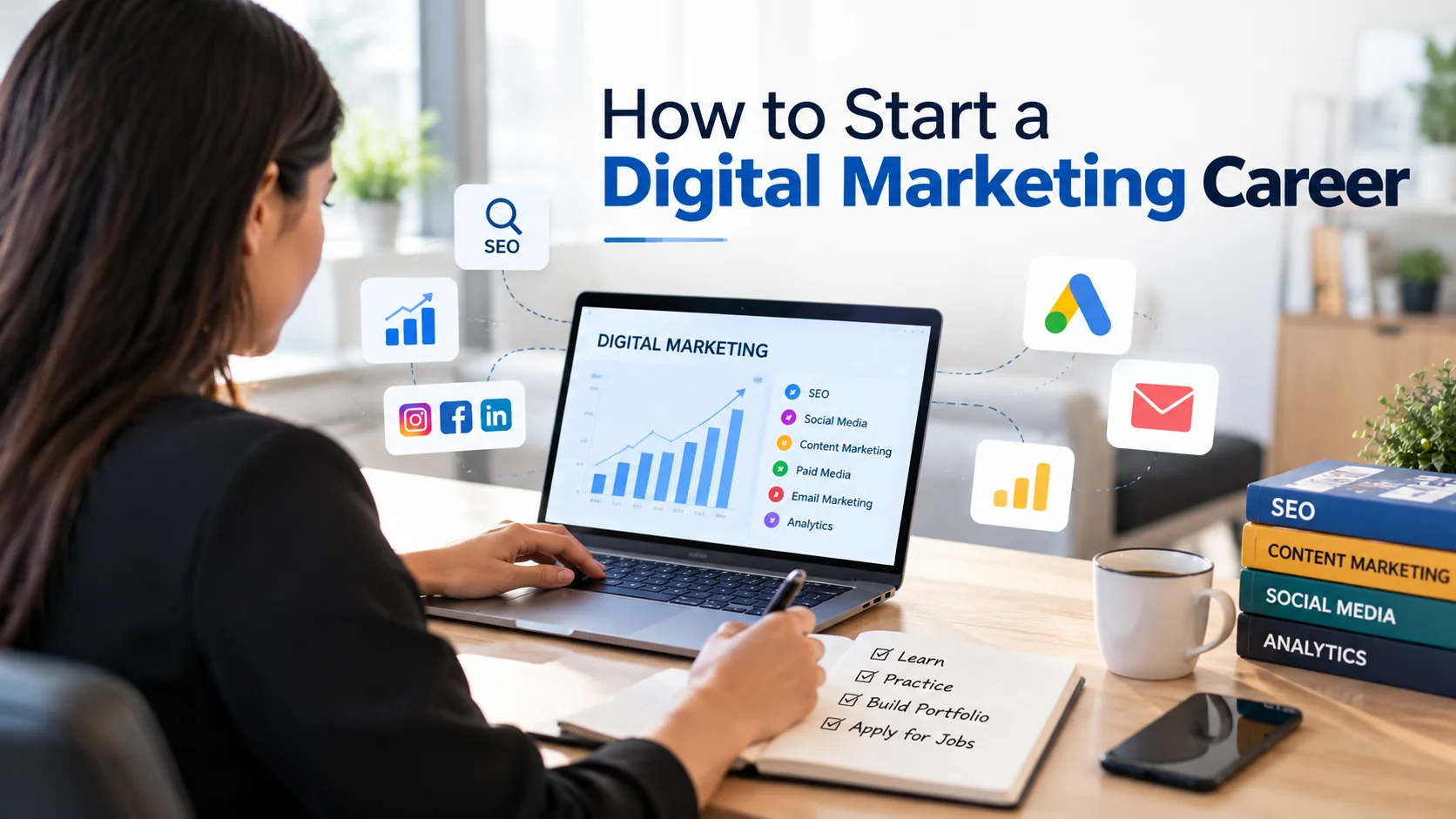
Starting a digital marketing career does not require learning every advertising platform at once. Begin by understanding customers and marketing goals, choose a skill to practice, and create work that shows employers how you think. This guide covers the main jobs, essential skills, a practical learning roadmap, certifications, portfolio projects, job applications, and salary research. A digital marketing career can develop through different specializations, so the right starting point depends on your interests, skills, and target job market. It is written for international readers; hiring rules, training prices, and pay differ by country.
What Is a Digital Marketing Career?
Digital marketing involves reaching, informing, and serving customers through websites, search engines, advertising, email, and social platforms. A digital marketer may plan campaigns, research audiences, create content, manage budgets, or measure results. The exact combination depends on the employer: a small company might hire a generalist, while an agency might employ separate SEO, advertising, and analytics specialists.
What Does a Digital Marketer Do?
Imagine an online clothing store that wants more qualified purchases. A marketer investigates customers’ questions, proposes useful product information, chooses promotional channels, and establishes how purchases will be measured. The work does not end when content goes live: marketers review results, investigate problems, and decide what to test next. Increased visits alone are not proof of success; traffic quality, measurement accuracy, and business objectives matter.
Digital Marketing Career Paths: Which Role Fits You?
| Path | Typical work | Beginner portfolio example |
| SEO | Search research, site improvement, content optimization | Keyword-to-page map |
| Paid media/PPC | Campaign planning, targeting, budgets, measurement | Unlaunched campaign brief |
| Content marketing | Audience research, articles, distribution | Editorial calendar |
| Social media | Platform planning, publishing, community response | Campaign content plan |
| Email marketing | Segmentation, email sequences, evaluation | Welcome sequence |
| Analytics | Tracking requirements, reports, interpretation | Sample measurement dashboard |
SEO Specialist
SEO specialists help people and search engines understand a website. They investigate search intent, map topics to pages, review titles and internal links, and identify technical problems. Begin with the Google SEO Starter Guide, then practice reviewing a website you own or have permission to inspect. A useful SEO portfolio shows the initial issue, your evidence, recommendations, and any genuinely observed outcome. Rankings cannot be guaranteed.
Paid Media and Performance Marketing Specialist
Paid media specialists plan advertisements, select audiences or keywords, manage budgets, and evaluate conversions. Begin with a campaign brief rather than spending money: define the product, audience, objective, proposed ad, landing page, budget assumptions, and measurement plan. Distinguish planned results from observed results. Real advertising requires permission, an appropriate account, and money the account owner has agreed to spend.
Content and Social Media Marketer
Content marketers research what audiences need and produce material that addresses those needs. Social media marketers adapt messages to specific platforms, organize publishing, and respond according to a brand’s guidelines. A beginner can produce a short editorial calendar with target audience, message, creative brief, distribution plan, and measurable objective. Do not treat follower growth or engagement as automatically equivalent to sales.
Email Marketing and Analytics Specialist
Email marketers create relevant messages and journeys, review deliverability and engagement, and respect consent requirements applicable to their audience. Analysts define what needs measuring, inspect available data, and explain findings along with limitations.
Essential Digital Marketing Skills for Beginners
Learn enough about each major channel to understand how a campaign fits together, then deepen the skills needed for your chosen role. For anyone building a digital marketing career, these fundamentals provide a foundation before specializing in SEO, paid media, content, social media, email, or analytics.
Technical Skills: Research, Content, Advertising, and Measurement
Learn customer research, search intent, basic keyword mapping, content planning, marketing funnels, and conversion concepts. Understand the difference between impressions, clicks, leads, purchases, and revenue. A click-through rate describes clicks relative to impressions; it does not by itself measure profitability. Practice spreadsheets for organizing research and comparing results. For advertising, understand targeting, creative, landing pages, budgets, and conversion tracking before attempting optimization.
Soft Skills: Communication, Judgment, and Collaboration
Marketers regularly explain decisions to people who are not specialists. Practice writing a one-page brief: state the business problem, evidence, proposed action, expected measurement, and uncertainty.
Do You Need a Degree or Coding Skills?
There is no single rule for every digital marketing job. Some employers specify degrees, while other openings emphasize a relevant portfolio or hands-on experience. Research-intensive occupations can have different requirements: the US Bureau of Labor Statistics describes a bachelor’s degree as typical for market research analysts, which should not be generalized to every marketing vacancy. Most introductory content and campaign exercises do not require programming, although familiarity with HTML, websites, spreadsheets, and tracking concepts can help. Follow the requirements of actual vacancies in your target location.
How to Start a Digital Marketing Career: Step-by-Step Roadmap
This is a learning sequence, not a promise that a certain number of weeks will lead to employment. Move forward when you can produce and explain the deliverable for each stage.
Step 1: Understand Customers and Marketing Goals
Choose an example product and identify its intended customers. Write down what they need, where they might research alternatives, and what action the business wants them to take. Sketch how search, content, social platforms, advertising, and email could contribute. Separate the awareness stage from a purchase or inquiry. Your deliverable is a one-page channel overview explaining the audience, business objective, and possible customer journey.
Step 2: Choose One Specialization
Read several genuine entry-level descriptions from your intended country and record repeated tasks and tools. Compare these with what you enjoy practicing: SEO research, writing, campaign planning, or analysis. Select one area for a first portfolio project without assuming you must choose it permanently. Your deliverable is a skill checklist and an ordered learning plan derived from relevant job duties.
Step 3: Build a Practice Project
Work on your own site, use a fictional business, or obtain explicit permission from a real organization. An SEO beginner might map ten search queries to appropriate page types; a content beginner might draft a five-piece calendar; an advertising beginner might design an unlaunched campaign. Save dated notes showing why you made each choice. Your deliverable is a coherent project, not disconnected screenshots of tools.
Step 4: Define Measurement Before Reporting
Decide what success would mean before interpreting results. For a content project, useful measures may include relevant visits and completed inquiries, if tracking exists. For an unlaunched advertising plan, specify proposed metrics but report no actual performance. Use Google’s Analytics setup documentation if you are configuring an authorized property. Your deliverable is a measurement plan stating events, data sources, limitations, and how findings would influence decisions.
Step 5: Assemble Your Portfolio and Apply
Turn the project into a concise case study showing the situation, objective, research, decisions, artifacts, and results where genuinely available. Ask someone to review whether your reasoning is understandable. Match your resume to suitable jobs, submit relevant work samples, and prepare to discuss trade-offs. Your deliverable is a portfolio page or PDF plus a truthful resume. Continue revising the portfolio as you gain experience.
| Learning stage | Evidence to create | What it demonstrates |
| Fundamentals | Customer and channel map | Understanding of marketing objectives |
| Specialization | Skill checklist | Focused learning decisions |
| Practice | Project brief and artifacts | Ability to apply concepts |
| Measurement | Metric and reporting plan | Analytical reasoning |
| Applications | Portfolio and resume | Clear presentation of work |
Build a Digital Marketing Portfolio Without Experience
Your first portfolio need not claim a paying client. A clearly labeled hypothetical project can show your process, provided invented business details and performance figures are never presented as real outcomes.
Example: A Fictional Clothing Store
Create a fictional sustainable clothing store called Pine & Thread. Its hypothetical goal is to help shoppers understand product features and increase qualified purchases. Define a specific customer group and list questions they might ask before buying: sizing, material, delivery, returns, or care. Note that these questions are assumptions until supported by actual customer research.
Develop a small research sheet containing candidate queries, the likely purpose behind each query, and the page type that would answer it. Do not invent keyword search volume or difficulty. Next, draft three article ideas and three social posts linking each concept to a customer question. If you choose an ecommerce storefront for practice, our WooCommerce tutorial for beginners provides related store-setup context; assess its version-specific instructions before implementation.
Turn the Exercise Into a Case Study
Present the project under six labels: objective, audience assumptions, research method, proposed strategy, deliverables, and evaluation plan. Include a keyword map, content calendar, draft landing-page outline, and simple reporting template. Explain one alternative you rejected and why. If you did not publish anything, say that the project is a simulation and that actual conversion results are unavailable.
A sample portfolio statement could read: “Designed a hypothetical ecommerce marketing plan covering audience questions, keyword mapping, content concepts, and measurement requirements.” This is an example of wording, not a claim about your employment history.
Digital Marketing Tools Beginners Should Learn
Choose tools according to the task. A tool is valuable when it helps you produce an understandable decision or artifact, not because it appears on a long resume list.
| Tool | Purpose | Safe beginner exercise |
| Google Search Console | Understand a verified site’s search performance | Review queries on a site you control |
| Google Analytics | Measure configured website or app activity | Explore an authorized property or demo |
| Google Ads | Plan and manage advertising | Draft a campaign without publishing |
| Meta Ads Manager | Set up Meta advertising | Study objectives and prepare a mock brief |
| Spreadsheet software | Organize research and reporting | Build a keyword map and report template |
Use demo environments when available, obtain permission before entering a client’s account, and never expose customer information in your portfolio. Learn each tool’s limits: tracking configuration, consent, attribution, and incomplete data can all affect interpretation.
Digital Marketing Certifications and Learning Resources
Certificates can structure your learning, but completion does not establish professional experience or guarantee employment. Compare curricula, current fees, assessments, and practical assignments rather than collecting credentials indiscriminately.
Google Career Certificate Versus Google Ads Certifications
The Google Digital Marketing & E-commerce Professional Certificate on Coursera is a broader learning program covering marketing and ecommerce subjects. Google Ads certifications are separate credentials available through Skillshop. Google’s guidance distinguishes foundational certifications from certain professional certifications with different access conditions. Verify the exact credential before calling it free.
HubSpot Academy and Official Documentation
HubSpot Academy’s digital marketing course offers an additional structured learning option. Google Search Central is useful for SEO fundamentals, while official product help centers explain platform setup and limitations. Pick a resource aligned with your intended role, finish a relevant exercise, and preserve the artifact.
How to Find Entry-Level Digital Marketing Jobs
Search for digital marketing assistant, junior SEO specialist, content assistant, marketing coordinator, PPC trainee, and internship titles. A job title alone is not enough: read responsibilities, required experience, working arrangements, and whether the employer expects a generalist or specialist.
Search Across Countries Without Mixing Requirements
For the US, UK, Canada, Australia, UAE, Pakistan, and India, use employer career pages and established job platforms with the location filter set explicitly. Compare listings within the same market; don’t assume a US degree requirement, salary, or remote-work policy applies elsewhere. Internationally advertised remote roles may restrict applicants by residence, work authorization, or time zone. Check those conditions before investing time in an application.
Present Your Skills in a Resume and Interview
Adapt the first part of your resume to the actual role. Show practical outputs such as research maps, campaign briefs, content plans, and reporting templates. Describe hypothetical work as hypothetical; do not imply a practice store was a paying client. Prepare interview answers that explain your objective, assumptions, evidence, alternative options, and next steps. When asked about an underperforming campaign, explain which tracking and audience questions you would investigate before recommending changes.
Internships, supervised volunteer assignments, and permitted freelance work can create genuine experience. Agree on scope, ownership, access, and any payment before beginning. Avoid presenting a speculative portfolio exercise as client work or revealing confidential results.
Digital Marketing Salary and Career Progression
Global salary averages are misleading when they combine countries, currencies, seniority, and different occupations. Compare dated listings and reputable occupational sources for the same role and location. Consider base pay, benefits, contract status, taxes, and whether advertised figures refer to annual or monthly compensation.
What Can a Verified Salary Source Tell You?
The US Bureau of Labor Statistics profile for market research analysts reports a median US annual wage of $78,760 for May 2025. That is the median for this specific occupation across experience levels, not an entry-level digital marketer salary and not a benchmark for Pakistan, India, or the UAE. A broad digital marketing article should not present it as a universal earnings promise.
How Can Your Career Develop?
A person may move from assistant to specialist, senior specialist, team lead, or manager, or remain an expert individual contributor. The path depends on business needs, demonstrated work, and opportunities. Career progression in digital marketing depends on the specialization you choose, the quality of your work, and the opportunities available in your target market.
How AI Fits Into Digital Marketing Work
AI tools can help brainstorm campaign questions, organize research notes, create draft outlines, and suggest report formats. They can also generate inaccurate claims, invented references, repetitive copy, and misleading interpretations. Review every factual statement and numerical result against its original source. Never upload private client data without permission and appropriate safeguards. Treat AI output as a draft for human verification, not as evidence that a campaign works or that a job will disappear.
Frequently Asked Questions
Can I Start Without Experience?
Some entry-level employers consider applicants with relevant skills and projects, but others require previous work. Start with fundamentals, finish a documented exercise, and examine actual vacancies in your market. A credible portfolio shows what you did and what remains untested.
How Long Does Learning Take?
There is no universal deadline. Your background, study time, chosen specialization, and opportunities for practice affect progress. Judge readiness by whether you can complete a relevant task and explain your reasoning, not by the number of course videos watched.
Can I Work Remotely?
Remote marketing jobs exist, but eligibility may depend on residence, time zone, employment rules, and company policy. Read the location and authorization requirements of every vacancy rather than assuming “remote” means worldwide.
Do Certifications Guarantee a Job?
No. They can demonstrate course completion or assessed knowledge, depending on the credential. Employers may also ask for practical examples, communication ability, and relevant experience. Treat certificates as one part of a broader application.
Your Next Step
Choose one digital marketing specialization, identify a customer problem, and complete a small documented project. Show your reasoning, label simulations, and use verified evidence where real results exist. Then build a concise portfolio and tailor applications to the requirements of your target market. A credible first project is more useful than an unsupported promise of quick
