
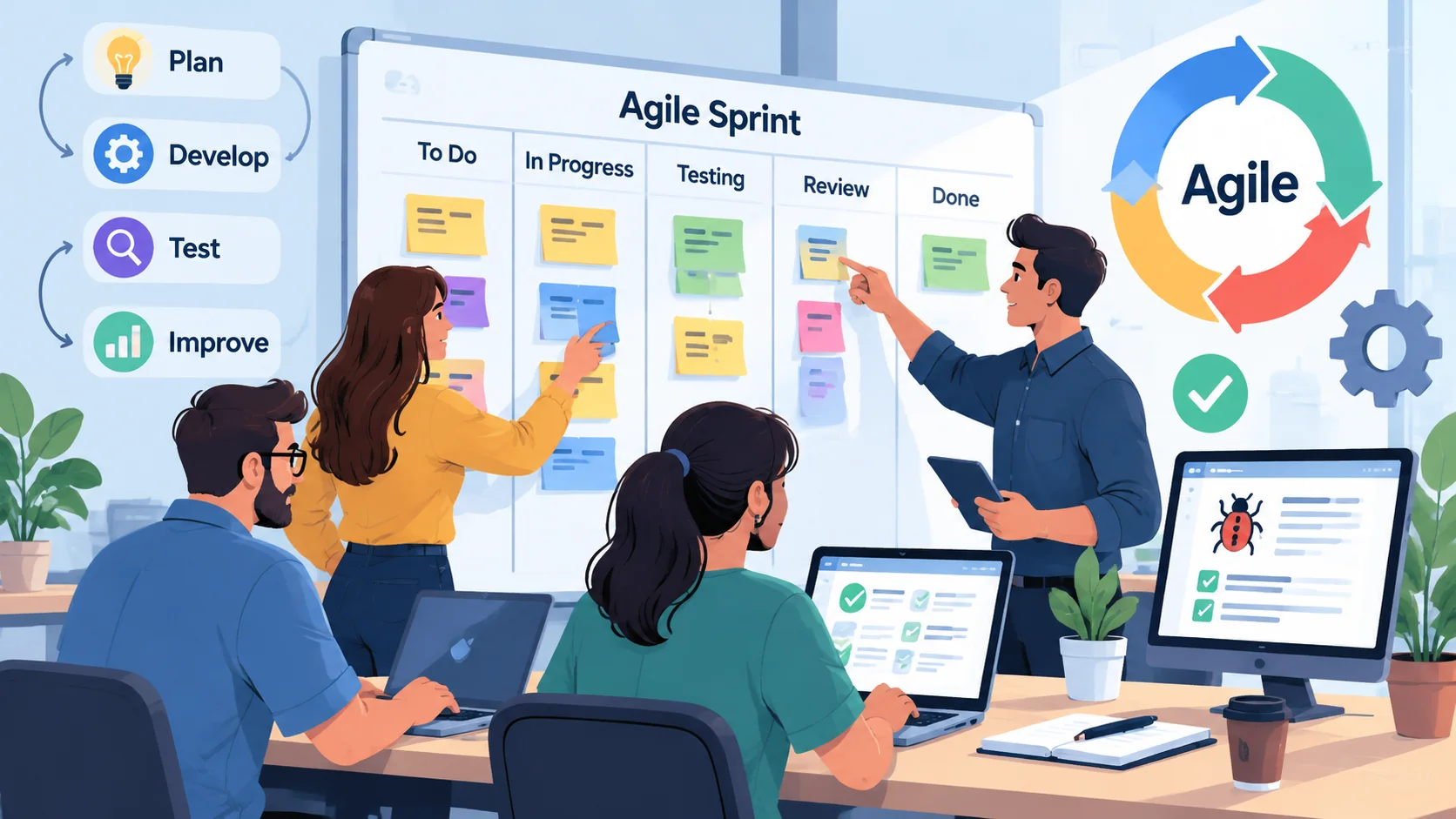
Agile testing is not a separate phase that starts after developers finish coding.
Testing happens throughout development. QA professionals can contribute before implementation by identifying unclear requirements and risks, during development by testing available components and APIs, and after implementation through functional, exploratory, regression and other appropriate testing.
This guide explains agile testing methodology, its lifecycle, Agile Testing Quadrants, common techniques such as TDD, BDD and ATDD, and what a QA engineer actually does throughout a sprint.
What Is Agile Testing Methodology?
Agile testing is testing performed within an Agile software development approach.
Instead of postponing most testing until development is complete, quality and testing activities happen alongside development and continue throughout each iteration.
This fits the broader Agile principles of collaboration, working software, frequent feedback and responding to change.
In practice, Agile testing involves early QA participation, collaboration between technical and business roles, continuous feedback, automated checks where repeatability matters, exploratory testing where human investigation is valuable, and adapting coverage as the product changes.
Agile does not mean abandoning planning or documentation. The goal is to keep both useful and adaptable rather than creating documentation simply because a process requires it.
How Agile Testing Differs From Traditional Testing
Traditional sequential development can organize requirements, development and testing into separate phases.
Agile development works in smaller increments and short feedback loops.
For QA, the important difference is timing.
A tester should not first think about quality when a completed feature arrives for testing. Potential risks, ambiguous requirements and testability problems can be identified much earlier.
Agile Testing vs Waterfall Testing
Agile testing methodology and Waterfall testing structure development and feedback differently. Agile focuses on continuous collaboration, while Waterfall usually follows sequential phases.
| Area | Agile Testing | Traditional/Waterfall Testing |
| Testing timing | Throughout iterations | Often concentrated after development |
| Feedback | Frequent | Usually later |
| Requirements | Can evolve | More heavily defined upfront |
| QA involvement | Starts early | Often stronger in later phases |
| Delivery | Incremental | Usually larger releases |
| Collaboration | Cross-functional | More phase-oriented |
| Change | Expected and managed iteratively | Often requires formal replanning |
The main advantage for QA is faster feedback.
Finding an unclear requirement before development usually costs less effort than discovering the same misunderstanding after implementation.
Core Principles of Agile Testing
The agile testing methodology is built around early feedback, collaboration, continuous testing and adapting quality practices throughout development.
Test Early
QA can contribute before any code exists.
During refinement and planning, useful questions include:
- What should happen with invalid input?
- What happens if an external service fails?
- Do different users have different permissions?
- What does successful completion mean?
- Can the requirement actually be tested?
These questions can prevent misunderstandings from becoming defects.
Test Continuously
Testing should begin when testable work becomes available rather than accumulating until the end of the sprint.
Depending on the product, this can include unit tests, API tests, integration tests, UI checks, exploratory testing and regression.
Collaborate With the Team
Quality improves when developers, product stakeholders and testers build a shared understanding of expected behaviour.
QA should clarify assumptions rather than simply receive completed work.
Get Fast Feedback
A useful test provides information early enough for someone to act on it.
A failed API test during implementation is normally more actionable than discovering the same problem during a large regression run immediately before release.
Treat Quality as a Team Responsibility
Testing expertise is valuable, but quality should not become something that developers hand over to QA.
Developers, testers and product stakeholders all contribute different information about product quality.
Agile Testing Lifecycle
There is no single rigid lifecycle that every Agile testing methodology implementation must follow. Agile testing is iterative, so the following activities repeat throughout development:
Backlog Refinement → Sprint Planning → Test Design → Development & Testing → Regression & Exploratory Testing → Sprint Review → Retrospective
1. Backlog Refinement
Testing work can begin while backlog items are still being clarified.
QA can identify:
- ambiguous requirements
- missing acceptance criteria
- risky scenarios
- integrations
- test-data requirements
- environment dependencies
- security concerns
- performance risks
- edge cases
This is an opportunity to prevent problems before implementation.
2. Sprint Planning
During planning, QA can assess:
- expected testing effort
- dependencies
- environment requirements
- test data
- browser/device requirements
- regression impact
- automation opportunities
The goal is not to produce a large formal test plan for every story. It is to understand enough risk and coverage to support the sprint.
3. Test Design
Test design can begin before development is complete.
Consider:
- positive scenarios
- negative scenarios
- boundaries
- validation
- permissions
- error handling
- integrations
- API behaviour
- UI behaviour
- data changes
- regression impact
The amount of documentation should reflect the complexity and risk of the feature.
4. Development and Continuous Testing
Testing begins as soon as meaningful components become available. QA does not always need to wait for the finished UI.
If an API endpoint exists first, API testing can begin first.
Developers may handle unit and component checks while QA investigates integration behaviour, business risk and end-to-end product behaviour.
5. Regression and Exploratory Testing
Regression testing checks that existing important behaviour still works after changes.
Exploratory testing serves a different purpose. The tester learns about the product while designing and performing tests, allowing discoveries to guide further investigation.
Both have value. Automation is useful for repeatable checks. Exploratory testing helps investigate risks that predefined automated tests may not cover.
6. Sprint Review and Release Validation
Before work is considered complete, the team should understand its quality state.
QA may contribute by confirming:
- acceptance criteria have been tested
- important defects are understood
- regression risk is acceptable
- required coverage has been completed
- unresolved issues are communicated clearly
7. Retrospective
Testing problems should also feed process improvement.
Useful retrospective questions include:
- Why did testing start late?
- Why was test data unavailable?
- Why did acceptance criteria change repeatedly?
- Which defects escaped?
- Which automated tests were unreliable?
- What testing activity created unnecessary delay?
- What should change next sprint?
QA’s Role Throughout an Agile Sprint
In an agile testing methodology, a QA engineer’s involvement can span the whole sprint.
| Sprint Activity | QA Contribution |
| Backlog refinement | Identify ambiguity, risk and testability issues |
| Sprint planning | Identify testing effort and dependencies |
| Before development | Clarify acceptance criteria and prepare scenarios |
| Development | Test available APIs/components and collaborate with developers |
| Feature testing | Functional, negative and exploratory testing |
| Regression | Check important existing behaviour |
| Sprint review | Communicate quality information |
| Retrospective | Identify process improvements |
These responsibilities do not mean QA owns quality alone. Quality remains a shared team responsibility.
User Stories, Acceptance Criteria and Definition of Done
These concepts work together but mean different things.
User Stories
A user story describes a requirement from the user’s perspective.
For example:
As a customer, I want to reset my password so I can regain access to my account.
QA should immediately look beyond the sentence itself.
Questions might include:
- Who can request a reset?
- How is the reset initiated?
- How long does the link remain valid?
- Can the link be reused?
- What happens for an unknown email address?
- What password rules apply?
Acceptance Criteria
Acceptance criteria describe conditions that need to be satisfied for the expected behaviour to be accepted.
For the password-reset story, criteria could include:
- registered users can request a reset
- the reset token expires after a defined period
- expired tokens cannot change the password
- passwords must meet defined requirements
- a successfully used token cannot be reused
Acceptance criteria are not the entire testing strategy. QA should still investigate additional edge cases and risks.
Definition of Done
The Definition of Done describes the quality conditions the team requires before work is considered complete.
Depending on the team, this could include:
- agreed testing completed
- required automated checks passed
- code review completed
- critical defects resolved
- documentation updated
- accessibility or security requirements checked
There is no universal Definition of Done that every team must copy.
Practical Agile Testing Example: Password Reset
Consider the same story:
As a customer, I want to reset my password so I can regain access to my account.
Before Development
QA first looks for ambiguity.
Questions may include:
- How long is the token valid?
- Can a reset link be used twice?
- What happens when an unknown email is entered?
- Can users repeatedly request reset links?
- Does a newer link invalidate older links?
- What password requirements apply?
- Should existing sessions remain active after the password changes?
Clarifying these points can improve the story before implementation.
During Development
QA can prepare or start work before the complete feature exists.
This can include:
- creating test accounts
- identifying APIs
- testing endpoints when available
- preparing negative scenarios
- preparing test data
- identifying browser/device coverage
- identifying regression tests suitable for automation
When the Feature Becomes Testable
Useful scenarios include:
- valid reset request
- valid token
- expired token
- invalid token
- reused token
- weak password
- mismatched password confirmation
- repeated reset requests
- unknown account
- successful login using the new password
Exploratory questions might include:
- What happens if two reset links are opened?
- What happens when the password changes in another session?
- Does an error disclose whether an account exists?
- Does the flow work correctly on mobile screens?
Before Sprint Completion
Relevant final activities could include:
- validating acceptance criteria
- login/account regression
- exploratory testing
- browser/device checks
- automation updates
- reviewing unresolved defects
This is a practical example of Agile testing: QA contributes throughout implementation instead of waiting for the completed feature.
Agile Testing Quadrants Explained
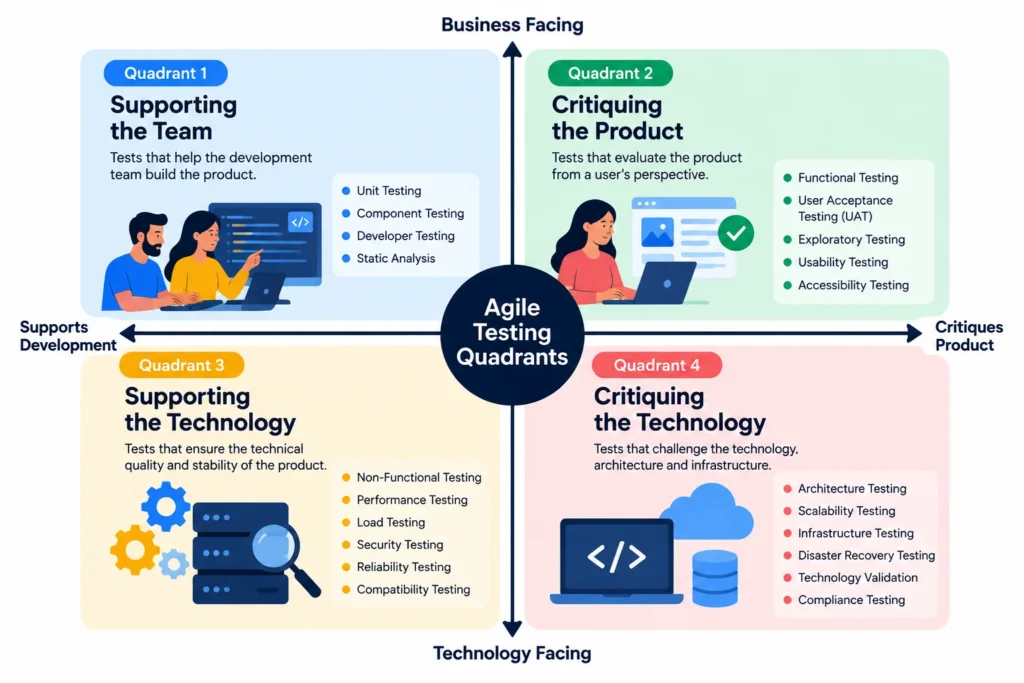
Agile Testing Quadrants help teams think about different testing purposes.
They organize tests around two dimensions: business-facing vs technology-facing and supporting the team vs critiquing the product.
Importantly, Q1 through Q4 are not four sequential sprint phases.
| Quadrant | Focus | Typical Examples |
| Q1 | Technology-facing, supports development | Unit and component tests |
| Q2 | Business-facing, supports development | Functional and acceptance tests |
| Q3 | Business-facing, critiques the product | Exploratory, usability and UAT |
| Q4 | Technology-facing, critiques the product | Performance, security and reliability |
Quadrant 1: Technology-Facing Tests That Support the Team
Examples include unit and component tests.
These are usually automated and provide fast technical feedback.
Quadrant 2: Business-Facing Tests That Support the Team
These help establish whether expected business behaviour is being implemented.
Examples include:
- functional examples
- story-level tests
- acceptance tests
Quadrant 3: Business-Facing Tests That Critique the Product
These evaluate the actual user or business experience.
Examples include:
- exploratory testing
- usability testing
- user acceptance testing
This quadrant is also a reminder that not every useful test can or should be automated.
Quadrant 4: Technology-Facing Tests That Critique the Product
Examples include:
- performance testing
- load testing
- security testing
- reliability testing
The required coverage depends on product risk.
Common Agile Testing Methods and Techniques
Test-Driven Development (TDD)
TDD uses tests to help drive code development.
A simplified cycle is: Write a failing test → implement enough code to pass → refactor
TDD is primarily a development technique rather than something that should simply be handed to QA.
Behavior-Driven Development (BDD)
BDD focuses collaboration on expected behaviour. It helps technical and business participants establish shared understanding about what the system should do.
BDD is broader than simply writing Given/When/Then statements.
Acceptance Test-Driven Development (ATDD)
ATDD focuses on agreeing acceptance expectations before implementation. QA, developers and business stakeholders can collaborate to clarify expected behaviour and use that understanding as a basis for testing.
Exploratory Testing
Exploratory testing combines learning, test design and execution.
It can be particularly valuable when:
- functionality is new
- risk is uncertain
- requirements are ambiguous
- scripted tests do not cover enough real user behaviour
Risk-Based Testing
Not every possible test carries equal value.
QA can prioritize based on the probability and impact of failure. A payment failure normally deserves more attention than a minor visual inconsistency.
Continuous Testing
Continuous testing integrates testing into the development and delivery workflow.
This might include:
- automated tests on commits
- API regression
- integration tests
- deployment smoke tests
- scheduled regression
- appropriate performance or security checks
Continuous testing should improve feedback, not simply create more automation.
TDD vs BDD vs ATDD
| Approach | Main Focus | Typical Collaboration |
| TDD | Code design and correctness | Mainly developers |
| BDD | Expected system behaviour | Developers, QA and business |
| ATDD | Acceptance expectations | QA, developers and business |
These are not competing testing tools. A team may use ideas from more than one approach.
Shift-Left Testing in Agile
Shift-left testing means bringing appropriate quality activities earlier into development.
Examples include:
- reviewing stories before coding
- identifying edge cases during refinement
- developer unit tests
- API testing before UI completion
- static analysis
- early integration testing
- discussing security requirements during design
Shift-left does not mean all testing happens early. Testing should continue throughout delivery. The goal is to find each type of problem at the earliest useful point.
Manual Testing vs Automation in Agile
Agile does not eliminate manual testing. The better question is: Which checks benefit from automation, and which require human judgment?
Good Candidates for Automation
Automation often provides value for:
- stable regression checks
- smoke tests
- API regression
- frequently executed tests
- stable critical workflows
- data-driven checks
- CI/CD execution
When Manual and Exploratory Testing Still Matter
Human investigation is particularly useful for:
- new functionality
- usability
- ambiguous behaviour
- unexpected interactions
- visual behaviour
- complex user journeys
- exploratory investigation
The goal should be useful feedback, not the highest possible automation percentage.
Agile Testing Tools
Agile testing methodology is not defined by a specific set of products. Tools simply support different parts of the workflow.
Common categories include Jira or similar platforms for work tracking, TestRail or Zephyr for test management, Selenium/Playwright/Cypress for browser automation, Postman or REST Assured for APIs, JMeter or k6 for performance testing, and CI/CD platforms for automated execution.
Common Challenges in Agile Testing
Teams adopting an agile testing methodology often face challenges around changing requirements, regression scope, automation maintenance and collaboration.
Requirements Change During a Sprint
Agile accommodates change, but changes still affect risk and testing.
QA should reassess:
- acceptance criteria
- current tests
- regression scope
- dependencies
- automation
- release risk
Acceptance Criteria Are Incomplete
QA should identify ambiguity before implementation wherever possible. Concrete questions are usually more useful than waiting until testing begins.
Testing Becomes a Sprint-End Bottleneck
An unhealthy pattern is: development for most of sprint → large batch reaches QA → testing cannot finish
Potential improvements include smaller stories, earlier testing, API/component testing, stronger collaboration and selective automation.
Regression Keeps Growing
Running every historical test after every small change is inefficient.
Use risk to decide:
- which tests always run
- which should be automated
- which can run less frequently
- which areas are actually affected
Test Environments Are Unstable
Unreliable environments create false failures and waste investigation time.
Teams may need to improve deployment consistency, test data, observability, dependency availability and reset processes.
Automation Becomes Expensive to Maintain
Automation is valuable only when its benefit justifies its maintenance. Prefer automating stable, repeatable and high-value scenarios.
Agile Testing Best Practices for QA Engineers
Following an agile testing methodology helps QA engineers maintain quality while supporting faster and more flexible delivery.
Use this as a practical sprint checklist:
- participate in backlog refinement
- clarify ambiguous acceptance criteria
- understand business risk before testing
- begin test design early
- test APIs/components early when possible
- combine automation with exploratory testing
- prioritize regression according to risk
- communicate blockers quickly
- keep automated tests maintainable
- learn from escaped defects
- discuss recurring testing problems in retrospectives
- avoid treating QA as the final quality gate
Common Agile QA Mistakes
Waiting Until Development Is Finished
This recreates a mini-Waterfall cycle inside each sprint. Testing activities should start earlier.
Treating QA as the Only Owner of Quality
Developers, QA and product stakeholders contribute different information about quality.
Writing Tests Without Understanding Risk
Large test suites can still provide weak coverage if they focus on low-impact scenarios.
Automating Unstable Features Too Early
Automation can create unnecessary maintenance if the behaviour or interface is still changing rapidly.
Treating Every Test as Equally Important
Prioritize based on product and business risk.
Ignoring Exploratory Testing
Passing predefined checks only proves that those checks passed. It does not establish that no other important problems exist.
Repeatedly Carrying Testing Into the Next Sprint
If testing regularly cannot finish, investigate the cause: stories may be too large, testing may begin too late, environments may be unstable, capacity may be unrealistic, requirements may be unclear, or regression may be too expensive.
Frequently Asked Questions About Agile Testing Methodology
What is Agile testing methodology?
Agile testing methodology integrates testing and quality activities throughout iterative development instead of treating testing as one separate final phase.
How is testing performed in Agile?
Testing can begin during refinement and continue through planning, development, integration, functional testing, exploratory testing, regression and release validation.
What are the phases of the Agile testing lifecycle?
A practical recurring flow is: Backlog refinement → Sprint planning → test design → development and testing → regression and exploratory testing → review → retrospective. These are recurring activities rather than rigid phases.
What are the four Agile Testing Quadrants?
The quadrants group testing by business-facing versus technology-facing tests and tests that support development versus tests that critique the product. They are a planning model, not a sequential process.
What is the role of a QA engineer in Agile?
QA may contribute to requirement clarification, risk analysis, test design, functional testing, exploratory testing, regression, automation and process improvement.
Is testing done in every sprint?
In iterative development, relevant testing and quality work should normally be part of producing each usable increment rather than being deferred to a later dedicated testing sprint.
What is the difference between Agile testing and Waterfall testing?
Agile testing typically integrates testing throughout iterative development, while sequential approaches often organize testing as a later phase after larger amounts of development are complete.
Is Agile testing manual or automated?
It includes both. Automation supports fast repeatable feedback, while manual and exploratory testing provide human investigation and judgment.
What is shift-left testing?
Shift-left testing moves appropriate testing and quality activities earlier in development, such as requirement reviews, unit testing, early API testing and static analysis.
What is the difference between TDD, BDD and ATDD?
TDD focuses on tests driving code development. BDD focuses on expected behaviour and collaboration. ATDD focuses on defining acceptance expectations before implementation.
Final Takeaway
A mature agile testing methodology helps teams build quality into the development process through continuous feedback.
It is about building quality feedback into the entire development process.
For QA engineers, that means getting involved before code is complete, clarifying expected behaviour, identifying risk, testing incremental work, combining automation with human investigation and helping the team continuously improve how quality is built into the product.
Tools and frameworks will change. A practical agile testing methodology balances automation, exploratory testing and continuous improvement so teams can deliver reliable software with better feedback.
The transferable skill is knowing what to test, why it matters, when feedback is most useful and how to communicate quality risk clearly.
