
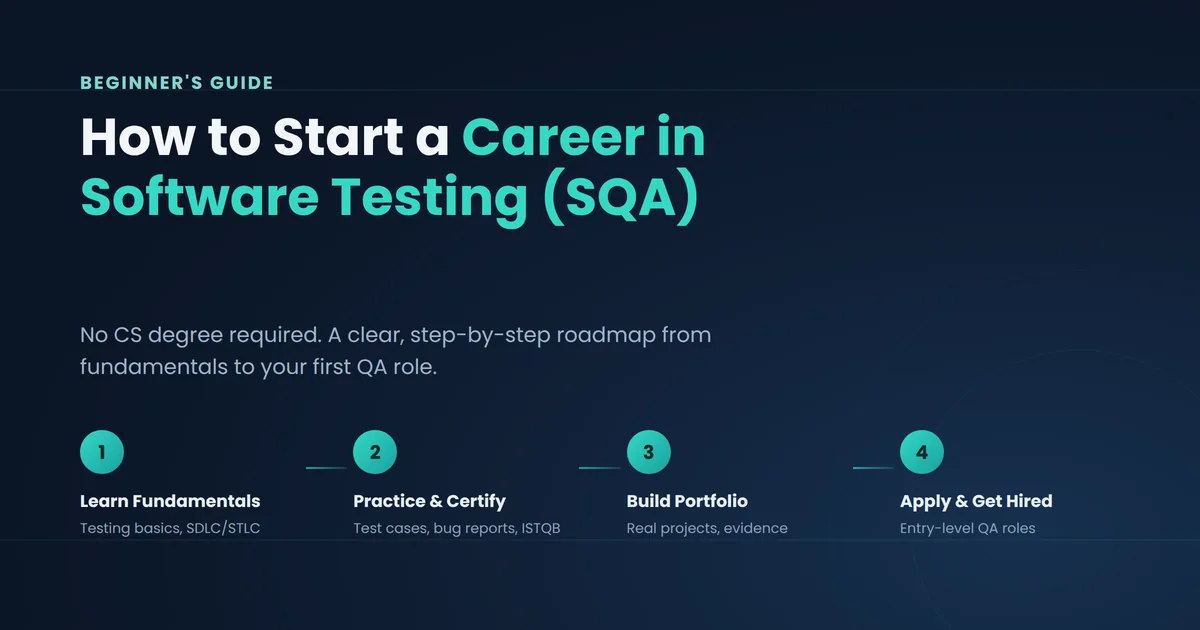
Starting a software testing career can feel confusing when you’re unsure whether you need a degree, coding skills, or certification. This guide explains how to build your skills, gain practical experience, and prepare for entry-level QA roles.
Here’s the honest version: none of those are strict requirements. What you actually need is a clear, sequential path — learn the fundamentals, practice on real software, build a small portfolio, and apply. This guide walks through that path step by step, based on how entry-level SQA roles are actually described and filled today.
What Does an SQA / Software Testing Career Actually Involve?
Software testers verify that an application behaves the way it’s supposed to — before real users find the problems. Day to day, this includes writing and executing test cases, reporting bugs clearly, retesting fixes, and communicating risk to the team.
Quality Assurance (QA) is the broader discipline: process, prevention, and standards. Software testing is the hands-on activity of executing checks and reporting what you find. As a beginner, you’ll usually start doing testing work under a QA or SQA title, and grow into broader QA responsibilities over time.
Do You Need a Computer Science Degree to Start?
No. A degree can help, particularly for automation-heavy or SDET (Software Development Engineer in Test) roles, but Many entry-level manual testing roles emphasize practical testing skills, communication, attention to detail, and structured thinking, although degree requirements vary by employer. Many working testers moved in from tech support, customer service, business analysis, or other non-coding backgrounds.
What actually matters for a first role:
- You can follow and write clear, reproducible steps
- You understand basic testing terminology
- You can explain what you tested, how, and what happened
- You’re comfortable learning new tools quickly
Manual Testing vs Automation Testing: Where Beginners Should Start
This is one of the most common points of confusion, so it deserves a direct answer:
Start with manual testing.
Manual testing means clicking through the application yourself, following test cases, and evaluating the result against what’s expected. It’s how you build the instinct for where bugs hide and how software is supposed to behave — a skill that automation scripts assume you already have.
Automation Testing
Automation testing means writing scripts that execute tests for you. It’s valuable for repetitive, stable checks and can open access to more technical QA roles, including automation and SDET positions.
| Approach | Best for | Learn coding first? |
| Manual testing | New testers, exploratory testing, unfamiliar features | No |
| Automation testing | Stable, repeatable checks; regression suites | Yes, after manual fundamentals |
Essential Skills for a Software Testing Career
1. Testing Fundamentals and Terminology
Learn the difference between a test case and a test scenario, defect severity vs priority, and the core testing types (functional, regression, smoke, sanity, exploratory).
2. SDLC and STLC
The Software Development Life Cycle (SDLC) is how software gets built. The Software Testing Life Cycle (STLC) is how testing fits into that process — from analyzing requirements through planning, designing tests, executing them, and reporting results. Testing isn’t a phase that starts after coding finishes; in most modern teams it runs alongside development.
3. Writing Test Cases and Bug Reports
A test case needs an objective, preconditions, steps, test data, and an expected result. A bug report needs to let someone else reproduce the problem without asking you follow-up questions, environment, steps, expected result, actual result, and evidence.
4. Helpful Extras (Optional, Not Mandatory)
Basic SQL (to check what’s actually in the database), browser developer tools (to inspect errors and network requests), and a basic understanding of how APIs work. None of these are required to get your first role, but each makes you noticeably more useful once you’re in one.
Is the ISTQB Foundation Level (CTFL) Certification Worth It?
If you’re considering certification, explore the official ISTQB Certified Tester Foundation Level (CTFL) syllabus to understand the testing concepts, exam topics, and skills covered. The current syllabus is CTFL v4.0.1, the previous v3.1 exam was retired in 2024, so make sure any course or practice material you use is aligned with v4.0.1.
| What it is | What it’s not |
| Proof you understand core testing terminology and concepts | A replacement for hands-on testing experience |
| Often listed as “preferred” in job postings | A guarantee of a job offer |
| A structured way to learn the fundamentals | A requirement everywhere, many companies hire without it |
CTFL can help you demonstrate foundational testing knowledge, but it works best alongside practical experience rather than replacing it. If you’re considering certification, explore our ISTQB Foundation Level certification guide for a detailed breakdown of the exam format, syllabus, and preparation process.
A Practical Software Testing Career Roadmap
There’s no single correct number of weeks — it depends on your starting point and available time. Here’s a reasonable structure to follow.
Stage 1: Learn the Fundamentals Work through testing terminology, SDLC/STLC, test case design, and defect reporting. Use the official ISTQB glossary and syllabus as your anchor rather than random blog posts.
Stage 2: Practice on Real Software Install a free or open-source application (or use a deliberately buggy demo site built for practice) and write real test cases against it. Log real bug reports. This is where theory turns into a skill you can talk about in an interview.
Stage 3: Certification, Portfolio, and Applying If you’re pursuing CTFL, take the official ISTQB sample exams under timed conditions. In parallel, put together a small portfolio: a few test cases, a couple of bug reports, and a short write-up of your testing process. Then start applying to entry-level QA tester, QA analyst, or software testing associate roles.
How to Start a Software Testing Career With No Experience
- Open-source projects: clone a repository, run the application, and log real bugs you find. It’s genuine, verifiable experience.
- Freelance/crowdtesting platforms (e.g., uTest, Test IO): short paid or portfolio-building testing gigs.
- Personal practice projects: deliberately buggy demo sites exist specifically for testers to practice on.
- Internships or contract roles: even a short contract is a real, resume-worthy credential.
- Tech support or QA-adjacent roles: if you’re already in tech support, you’re closer to QA than you might think; the troubleshooting instincts transfer directly.
Tools Every Beginner QA Tester Should Know
| Tool | What it’s for |
| Jira (or similar) | Logging and tracking bugs and test tasks |
| Browser DevTools | Inspecting errors, network requests, console logs |
| Postman | Basic API request/response testing |
| Selenium or Playwright | Browser automation (learn after manual fundamentals) |
You don’t need to master all of these before applying. Knowing what each one is for and having practical experience with at least one tool can help you prepare for entry-level roles. For a closer look at their features and use cases, explore our guide to software testing tools.
What Can an Entry-Level QA Tester Earn?
QA compensation varies widely by location, company, role title, and whether the position includes automation. Current US salary sources show substantial variation, so these figures should be treated as general market references rather than guaranteed entry-level pay.
| Source | Entry-level range (US) |
| Glassdoor | ~$55,000–$70,000/year |
| Indeed (updated Jul 2026) | ~$38/hour average across QA tester postings |
| ZipRecruiter | ~$28–$49/hour for entry-level QA software tester roles |
These figures move with location, remote vs on-site, and company size, treat them as a general reference, not a guarantee, and check current listings in your specific market before negotiating.
Common Beginner Mistakes
- Trying to learn automation before understanding manual testing
- Treating a vague scenario (“test login”) as a complete test case
- Assuming a certification alone will get you hired without any practice
- Guessing at a bug’s root cause instead of reporting what you actually observed
- Applying only to roles that require years of experience you don’t have yet, entry-level and junior postings exist specifically for this stage
Frequently Asked Questions
Do I need to know how to code to become a QA tester?
Not for most entry-level manual testing roles. Coding becomes important if you move into automation testing or an SDET role later.
How long does it take to start a software testing career?
It depends on your starting point and time invested, but a focused beginner following a structured plan (fundamentals → practice → certification/portfolio → applying) can be job-ready in a few months.
Should I learn manual or automation testing first?
Manual testing first. It builds the judgment automation scripts assume you already have.
Is ISTQB certification required to get a job?
No. It’s often preferred or valued, especially without other experience, but many testers are hired based on demonstrated skills and a small portfolio instead.
Is software testing a good entry point into tech?
It’s one of the more accessible entry points, since it doesn’t require deep programming knowledge upfront, and many roles offer remote flexibility. Like any tech role, demand and expectations still vary by company and market.
Final Takeaway
You don’t need a computer science degree, advanced coding skills, or a certification to begin a software testing career. What you need is a sequence: understand the fundamentals, practice on real software, write real test cases and bug reports, then apply with a small portfolio to back up what you know. Certifications like ISTQB CTFL can support that path, they shouldn’t replace it.
