
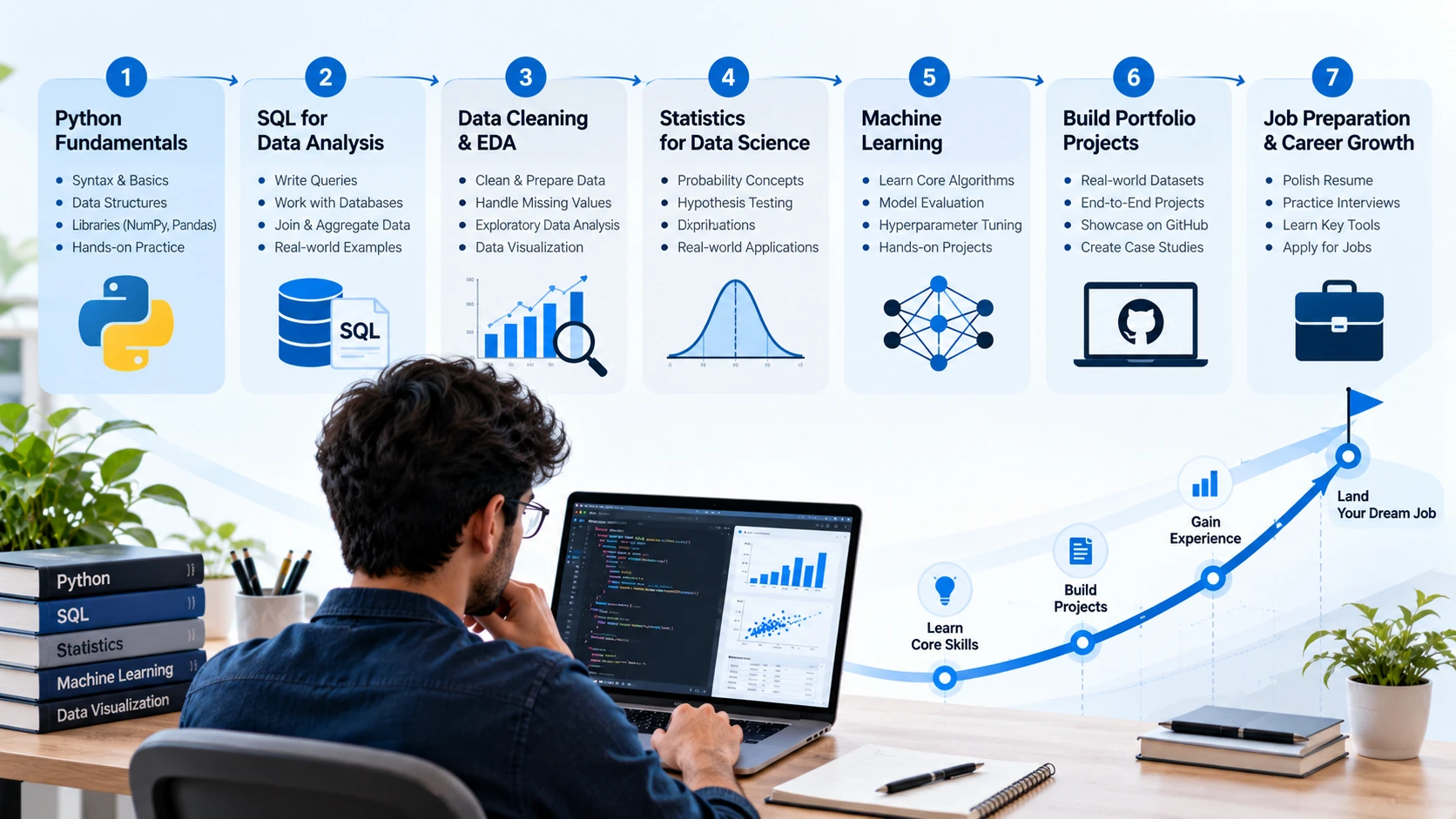
A data science career can feel difficult to plan because the field combines programming, SQL, statistics, data cleaning, visualization, machine learning, business reasoning, and communication. Beginners often see long tool lists and start learning everything at once, which makes it hard to know whether they are actually progressing toward a job.
A useful data science career roadmap solves that problem by putting skills in a practical order and attaching each stage to something you can build or explain. Start with Python and SQL, learn to clean and explore data, develop statistical reasoning, add machine learning only after the foundations are comfortable, and then turn those skills into documented projects and interview evidence.
This guide is for students, graduates, career switchers, and self-taught learners. It does not promise a fixed job-ready timeline; progress depends on your background, study time, target role, market, and project quality.
What Is Data Science?
Data science uses analytical and computational methods to extract useful information from data and support decisions. The work can include defining a problem, collecting or querying data, cleaning it, exploring patterns, testing assumptions, building models, evaluating results, and communicating what the analysis means.
The role is broader than training machine-learning models. A technically accurate model is not very useful if the underlying data is poor, the evaluation is misleading, or stakeholders cannot understand how the result should influence a decision.
Is Data Science a Good Career to Explore?
Data science remains a significant career area, but demand and entry requirements vary by country, industry, and employer. In the United States, the Bureau of Labor Statistics projects employment of data scientists to grow 35% from 2025 to 2035. That is U.S.-specific labor-market evidence, not a guarantee about hiring in every country or about any individual candidate.
Before committing to this path, compare data work with other technology roles in the tech career roadmap. A short practical exercise in SQL or data analysis can tell you more about your fit than choosing a field only because it is described as in demand.
What Does a Data Scientist Actually Do?
- Translate a business or research question into an analytical problem.
- Query, combine, clean, and validate data before analysis.
- Explore data and use statistics to test assumptions or quantify uncertainty.
- Build and evaluate predictive or descriptive models when the problem requires them.
- Create charts, reports, or explanations that make findings understandable.
- Document assumptions, limitations, and reproducible steps so others can review the work.
The balance changes by role. Read real vacancies in your target market instead of assuming every “data scientist” job uses the same stack.
Core Skills for a Data Science Career
| Skill | What to Learn | Evidence You Can Build |
| Python | Syntax, functions, data structures, files, notebooks | Small scripts and analysis notebooks |
| SQL | SELECT, filtering, joins, aggregation, CTEs, window functions | Queries that answer business questions |
| Data analysis | pandas, NumPy, cleaning, EDA | Cleaned dataset with documented analysis |
| Statistics | Distributions, sampling, confidence intervals, hypothesis testing, regression concepts | Analysis that explains assumptions and uncertainty |
| Visualization | Clear charts, dashboards, data storytelling | Report or dashboard tied to a decision |
| Machine learning | Supervised/unsupervised learning, validation, metrics, feature engineering | End-to-end model with honest evaluation |
| Git & communication | Version control, README files, concise explanations | Reviewable repository and project write-up |
Data Science Career Roadmap: Learn in This Order
Treat the stages below as gates rather than a checklist of tools. Move forward when you can produce the practical outcome for a stage without copying every step from a tutorial.
Phase 1 — Learn Python Fundamentals
Learn variables, conditions, loops, functions, collections, modules, file handling, and basic error handling. The official Python tutorial is useful once you have basic programming context. CareerTechGuide also has a Python for beginners guide for a gentler introduction.
Milestone: load a small CSV, calculate a few summaries, and write reusable functions without copying the entire solution.
Phase 2 — Learn SQL Early
Do not postpone SQL until the end. Learn SELECT, WHERE, GROUP BY, JOINs, subqueries, common table expressions, and window functions. Practice on a relational dataset and explain why each query answers the business question. SQL is not just syntax; it teaches you how structured data is organized and combined.
Milestone: answer five to ten realistic questions from multiple related tables and save the queries with short explanations.
Phase 3 — Learn Data Cleaning, pandas, and EDA
Use pandas to work with tabular data. Its official getting-started material covers reading data, selecting rows and columns, summary statistics, reshaping, combining tables, plotting, and other common operations.
Practice missing values, duplicates, inconsistent categories, dates, data types, outliers, joins, and validation. Then perform exploratory data analysis (EDA): ask questions, inspect distributions and relationships, identify suspicious patterns, and record what the data cannot tell you.
Milestone: publish an EDA project that includes the data source, cleaning decisions, charts, findings, and limitations.
Phase 4 — Build Statistical Reasoning
Learn descriptive statistics, probability basics, sampling, distributions, confidence intervals, hypothesis testing, correlation, and regression concepts. The goal is not to memorize formulas. You should understand what a method assumes, what question it answers, and when a conclusion is stronger than the evidence allows.
Milestone: analyze a question with an appropriate statistical method and explain the result in plain language, including uncertainty and limitations.
Phase 5 — Learn Machine Learning Fundamentals
After you can clean, explore, and reason about data, move into supervised and unsupervised learning. Learn regression, classification, clustering, feature engineering, train/validation/test splits, cross-validation, baseline models, overfitting, and appropriate evaluation metrics.
scikit-learn provides tools for preprocessing, model fitting, model selection, and evaluation. Use it to learn the workflow, not just to call algorithms. A model is incomplete if you cannot explain the baseline, metric choice, leakage risks, and limitations.
Milestone: compare more than one reasonable model on the same problem and explain why the selected evaluation metric fits the task.
Phase 6 — Add AI Skills Without Skipping the Foundations
Generative AI and large language models can be relevant to modern data work, but they should extend rather than replace core data skills. Learn at a practical level how embeddings, retrieval, model evaluation, privacy, reproducibility, and cost or latency trade-offs affect AI-enabled applications. Do not describe an LLM demo as evidence of data-science depth if it contains no meaningful data analysis or evaluation.
Milestone: add an AI component only when it solves a clear problem, and document how you evaluated its output rather than presenting a few successful examples.
Phase 7 — Build a Portfolio That Looks Like Real Work
A portfolio should show how you think, not how many notebooks you can upload. Aim for a small set of polished projects that cover different parts of the workflow. Each project should clearly state the problem, data source, cleaning choices, analysis or modeling approach, evaluation, findings, limitations, and next steps.
| Project | Skills Demonstrated | What Makes It Strong |
| Business EDA project | SQL/pandas, cleaning, visualization | Answers clear questions and documents data limitations |
| Dashboard or analytical report | Visualization, communication | A non-technical reader can understand the decision or insight |
| Prediction project | Feature work, ML, evaluation | Includes baseline, validation, metrics, and limitations |
| Optional AI/data project | AI integration and evaluation | Shows why AI was used and how output quality was checked |
Milestone: at least two or three projects that you can explain from the original problem through the final conclusion. Quality and explainability matter more than an arbitrary project count.
Phase 8 — Prepare for Data Science Job Applications
Compare your portfolio with current junior or entry-level vacancies in the country where you intend to work. Record repeated requirements and separate essential skills from preferences. If SQL, experimentation, cloud tools, or a degree appears repeatedly in suitable roles, treat that as market evidence and adjust your plan rather than following a generic roadmap blindly.
- Practice SQL and Python exercises without relying on autocomplete for every step.
- Be ready to explain one project deeply, including mistakes and trade-offs.
- Review statistics and model-evaluation concepts in plain language.
- Tailor your resume to the target role instead of listing every tool you have tried.
- Keep GitHub repositories readable, reproducible, and free of credentials or private data.
An Example Learning Plan
This is an example sequence, not a guaranteed job-ready timeline. Spend longer on any stage that you cannot yet demonstrate independently.
| Stage | Main Focus | Exit Evidence |
| 1 | Python fundamentals | Small programs and data-loading exercise |
| 2 | SQL | Multi-table query set with explanations |
| 3 | pandas + cleaning + EDA | Documented exploratory analysis |
| 4 | Statistics | Analysis with assumptions and uncertainty |
| 5 | Machine learning | Validated end-to-end ML project |
| 6 | Portfolio + communication | 2–3 polished, explainable projects |
| 7 | Applications + interviews | Role-specific resume and gap tracker |
Data Science Career Paths: Choose the Role Before Over-Specializing
| Role | Typical Emphasis | Good Early Evidence |
| Data Analyst | SQL, dashboards, reporting, business questions | SQL analysis + dashboard/report |
| Data Scientist | Statistics, experimentation, ML, communication | EDA/statistics + evaluated ML project |
| Machine Learning Engineer | Software engineering, deployment, ML systems | Production-oriented ML project |
| Analytics Engineer | SQL, data modeling, transformation, analytics infrastructure | Well-modeled analytical dataset and documentation |
| AI / Applied AI Engineer | Application engineering, model APIs, evaluation | Evaluated AI application with clear trade-offs |
These titles overlap across companies. Use the job description, not the title alone, to decide which skills to prioritize.
Do You Need a Degree for Data Science?
There is no universal degree rule for every employer or country. In the United States, the Bureau of Labor Statistics lists a bachelor’s degree as the typical entry-level education for the data scientist occupation and notes that some employers require or prefer graduate degrees. Individual vacancies can differ, and requirements in other countries may not match U.S. occupational patterns.
If you do not have a related degree, do not assume a portfolio automatically replaces one. Focus on vacancies whose stated requirements you can realistically meet, strengthen your project evidence, and consider adjacent entry routes such as data analysis when they better match your current skills.
Common Mistakes Beginners Make
- Jumping into deep learning or generative AI before Python, SQL, data cleaning, and statistics are comfortable.
- Collecting certificates without producing work you can explain independently.
- Treating SQL as optional or learning only very basic queries.
- Using clean tutorial datasets exclusively and never practicing messy real-world data.
- Reporting model accuracy without a baseline, proper validation, or the right metric.
- Uploading notebooks with no README, business question, limitations, or conclusions.
- Trying to learn every data and AI tool instead of building depth around a target role.
- Assuming a fixed number of months guarantees job readiness.
How Do You Know When You Are Ready to Apply?
You do not need to know every tool. A better readiness check is whether you can independently complete and explain the core workflow for the roles you are targeting.
- Write useful Python and SQL without copying an entire solution.
- Clean and validate a messy dataset and explain the decisions.
- Perform EDA and create charts that answer a specific question.
- Explain basic statistical uncertainty and common modeling assumptions.
- Build, validate, and compare machine-learning models using appropriate metrics.
- Use Git and write a README that another person can follow.
- Discuss project limitations honestly and explain what you would improve.
- Match your evidence to repeated requirements in current relevant vacancies.
Frequently Asked Questions
Is data science good for beginners?
Yes, beginners can learn data science, but the field combines several disciplines. Start with programming, SQL, data analysis, and statistics before treating advanced machine learning or AI as the main goal.
Should I learn Python or SQL first?
You can start with basic Python and introduce SQL early rather than waiting until Python is “finished.” Data work often requires both, and practicing them together helps connect code with real datasets.
Should I learn machine learning before statistics?
Learn basic statistical reasoning first. You do not need advanced mathematics before touching machine learning, but you should understand distributions, sampling, uncertainty, correlation, and evaluation concepts well enough to interpret results.
Can I become a data scientist without a degree?
Some employers consider candidates through nontraditional routes, while others specify a degree or advanced education. Requirements vary by role and country, so check actual vacancies and do not assume projects override a stated education requirement.
How long does it take to become job-ready?
There is no reliable universal timeline. Previous experience, weekly study time, target role, project quality, and local hiring requirements all matter. Use independent project milestones and real job descriptions to judge progress.
How many portfolio projects do I need?
There is no magic number. Two or three polished projects that demonstrate different skills and that you can explain deeply can be more useful than many copied notebooks. Match the portfolio to the roles you plan to apply for.
Do beginners need generative AI skills?
Basic AI literacy can be useful, but it should not replace Python, SQL, data cleaning, statistics, model evaluation, and communication. Add AI skills after the foundations are strong enough to evaluate the output critically.
Final Thoughts
The best data science career roadmap is not the one with the longest list of technologies. It is the one that helps you build skills in the right order and produces evidence at every stage: Python and SQL exercises, a clean EDA project, statistical reasoning, an evaluated machine-learning project, and clear communication.
Keep the roadmap flexible. Tools will change, and job titles will overlap, but the ability to frame a problem, work carefully with data, evaluate evidence, explain limitations, and communicate a useful conclusion remains durable. Review current vacancies periodically and use the gaps you find to decide what to learn next.
