
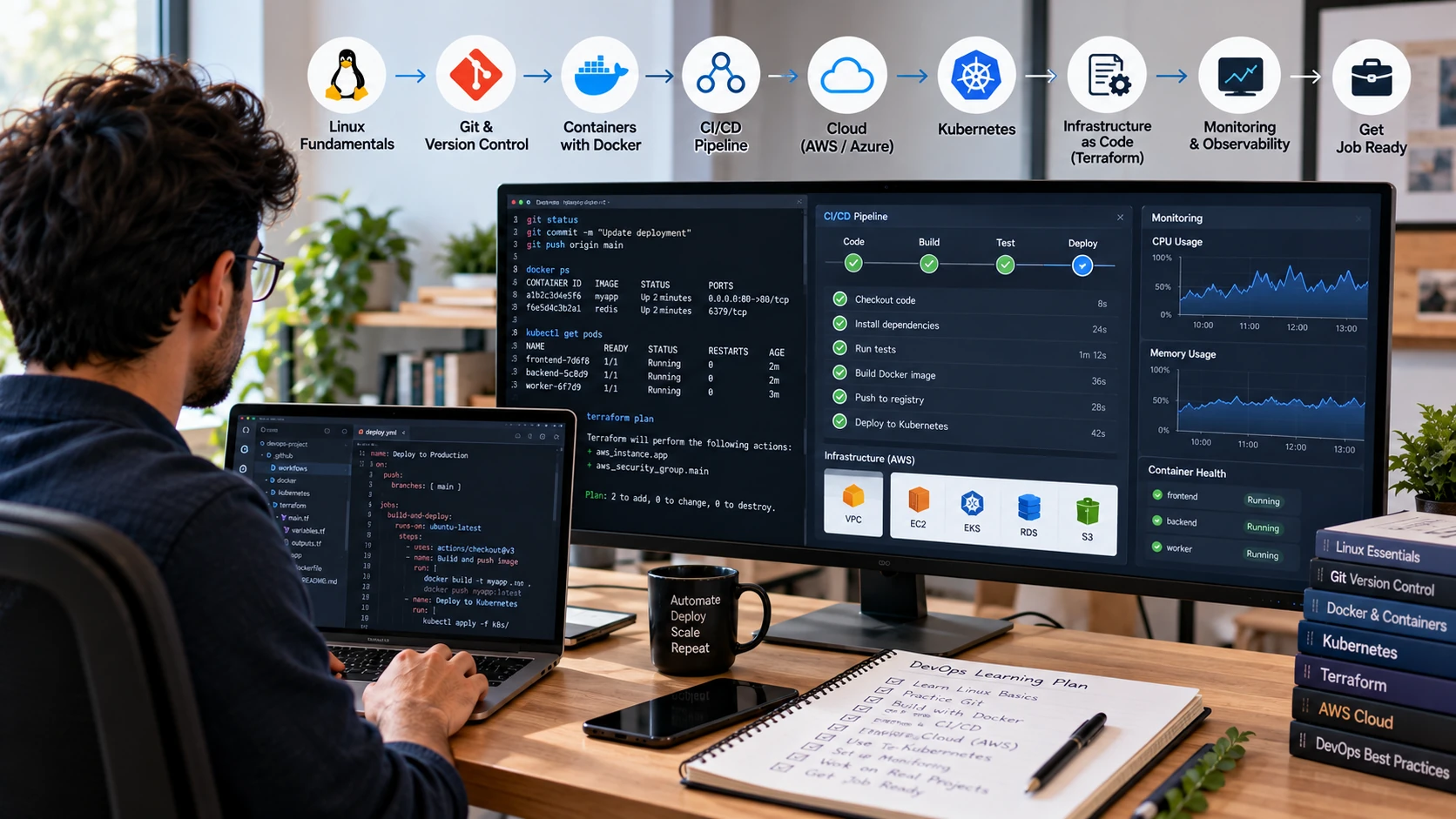
Starting a DevOps career can feel confusing because the role sits across software delivery, systems, cloud infrastructure, automation, security, and reliability. The common beginner mistake is to treat DevOps as a list of tools and jump directly into Kubernetes or Terraform without understanding the systems underneath them.
A better DevOps career path is sequential. Learn Linux and networking first, use Git to understand how code changes flow, add scripting and one cloud platform, then learn containers, CI/CD, infrastructure as code, Kubernetes, monitoring, and security. Each stage should produce something you can build, troubleshoot, and explain.
This DevOps career guide turns that sequence into a practical roadmap. It covers the skills to learn, what each tool solves, projects that demonstrate ability, certification decisions, and the evidence to prepare before applying for DevOps-related roles.
What Is DevOps and What Does a DevOps Engineer Do?
DevOps is a set of practices and ways of working that connect software development and IT operations so teams can build, test, release, operate, and improve software more reliably. A DevOps engineer may automate delivery pipelines, manage infrastructure, improve deployment processes, monitor services, and help teams investigate production problems.
A simplified delivery flow looks like this: code change → version control → automated build and tests → packaged application → infrastructure → deployment → monitoring → troubleshooting and improvement. The exact tools differ between organizations, but understanding this flow is more important than memorizing a long tool list.
If you are still comparing infrastructure work with other technology paths, use the tech career roadmap to compare the work, learning evidence, and entry requirements of different roles.
Is DevOps a Good Career Path for You?
DevOps may suit you if you enjoy understanding how applications run after developers write the code. The work often combines troubleshooting, automation, infrastructure, collaboration, and operational responsibility. Depending on the organization, related paths can include DevOps Engineer, Cloud Engineer, Site Reliability Engineer (SRE), Platform Engineer, or infrastructure automation roles.
It is not a shortcut into technology. Some employers expect previous development, systems, support, or cloud experience because production infrastructure carries real operational risk. Beginners should therefore focus on demonstrable fundamentals and realistic entry points rather than assuming that learning several tool names guarantees a DevOps title.
Skills You Need Before Advanced DevOps Tools
A practical DevOps career guide should begin with the fundamentals that advanced tools depend on. Linux, networking, Git, and scripting give you the base needed to understand cloud platforms, containers, automation, and production troubleshooting.
Linux and the Command Line
Learn filesystem navigation, users and permissions, processes, services, package management, SSH, logs, environment variables, and basic Bash. You should be able to connect to a Linux machine, inspect a running service, read logs, change permissions safely, and troubleshoot a simple failure.
Networking Fundamentals
Understand IP addressing, DNS, ports, TCP, HTTP/HTTPS, firewalls, routing basics, and load balancing. These concepts appear repeatedly in cloud networks, containers, Kubernetes services, reverse proxies, and production troubleshooting.
Git and Scripting
Learn repositories, commits, branches, merges, pull-request workflows, and how automation reacts to repository events. For scripting, Bash is useful around Linux workflows, while Python can help with automation and APIs. If Python is new to you, the Python for beginners guide provides a separate programming foundation.
DevOps Career Guide: Complete Roadmap
Follow the stages in order, but revisit earlier skills whenever a project exposes a gap. The milestone at the end of each stage matters more than the number of tutorials completed.
Phase 1: Linux, Networking, and Git
Learn Linux administration basics, networking concepts, Git, and shell scripting. Milestone: configure a Linux web server from the command line, access it over SSH, store your configuration notes in Git, and troubleshoot one intentionally introduced problem.
Phase 2: Learn One Cloud Platform
Choose AWS, Azure, or Google Cloud rather than trying to learn all three at once. Understand compute, storage, identity, networking, security groups/firewalls, and monitoring. Milestone: deploy a small service to a disposable cloud environment and document the architecture and cleanup steps.
Phase 3: Docker and Containers
Learn images, containers, Dockerfiles, registries, volumes, networks, and basic multi-container workflows. Milestone: containerize a small application and run it consistently on another environment.
Phase 4: CI/CD Automation
Understand continuous integration and delivery concepts before choosing a platform. Learn how a pipeline checks out code, runs tests, builds an artifact or image, and performs a controlled deployment. Milestone: create a pipeline that automatically validates and packages your project after a Git change.
Phase 5: Infrastructure as Code
Learn why infrastructure should be repeatable and reviewable. Terraform is a common option for provisioning; configuration-management tools may solve a different problem. Milestone: provision a small cloud environment from code and destroy it safely when finished.
Phase 6: Kubernetes Fundamentals
Move to Kubernetes only after containers make sense. Learn pods, deployments, services, configuration, secrets concepts, health checks, and basic troubleshooting. Milestone: deploy your containerized application locally or in a permitted lab and diagnose a failed deployment.
Phase 7: Monitoring, Observability, and Reliability
Learn the difference between logs, metrics, traces, alerts, and dashboards. Practice identifying symptoms before changing systems. Milestone: add basic monitoring to your project and document how you would investigate one failure.
Phase 8: DevSecOps and Operational Safety
Add security throughout the workflow: least-privilege access, secret handling, dependency and image scanning, secure configuration, patching, and reviewable changes. Milestone: document security controls and remove credentials from code and repositories.
DevOps Tools: Learn the Problem Before the Product
| Problem Area | Example Tools | What You Should Understand |
| Version control | Git, GitHub/GitLab | Changes, branches, collaboration, triggers |
| Containers | Docker | Images, runtime, networking, storage |
| CI/CD | GitHub Actions, GitLab CI/CD, Jenkins | Build, test, artifact, deployment flow |
| Cloud | AWS, Azure, Google Cloud | Compute, network, identity, storage, monitoring |
| Infrastructure as code | Terraform | Repeatable provisioning, state, reviewable changes |
| Orchestration | Kubernetes | Desired state, workloads, services, configuration |
| Observability | Prometheus, Grafana, cloud-native tools | Metrics, alerts, dashboards, investigation |
You do not need every tool in each category. Pick one workable stack, understand the concepts, and learn alternatives when a project or employer requires them.
Build One Connected DevOps Portfolio Project
A strong DevOps career guide should also include hands-on project work, because employers need evidence that you can connect tools into a working delivery process rather than simply name them.
Separate mini-projects are useful, but one connected project shows whether you understand how the pieces work together. Use your own application, a simple static site, or another project you are authorized to deploy.
- Store the project in Git with a clear README and sensible commit history.
- Containerize it with Docker and document how to run it locally.
- Create a CI workflow that runs a basic validation or test and builds the container image.
- Provision a small practice environment with infrastructure as code.
- Deploy the application and keep credentials outside the repository.
- Add basic health monitoring or an alert.
- Write a short troubleshooting note describing one failure, the evidence you checked, the root cause, and the fix.
- Include cleanup instructions so cloud resources do not remain running unnecessarily.
A portfolio should show your own decisions and limitations. Do not present tutorial work as production experience, expose credentials, or claim reliability improvements that you did not measure.
DevOps Certifications: Choose by Target Role
Certifications can provide structured learning or validate knowledge within a defined vendor ecosystem, but they should not replace hands-on work. Avoid a rigid beginner-to-advanced certification ladder because the useful credential depends on your target role, current experience, cloud platform, and employer requirements.
For example, a learner targeting an AWS-heavy role may investigate AWS certifications; someone working toward Kubernetes administration may later evaluate a Kubernetes credential. Check the current official exam objectives, prerequisites, costs, and job descriptions in your target market before paying for an exam.
How to Prepare for Your First DevOps-Related Role
A useful DevOps career guide should eventually connect your technical learning with real job requirements. Search current vacancies in the country where you plan to work and record recurring skills, tools, and experience requirements. Entry points vary, and some candidates move from IT support, systems administration, software development, cloud support, or junior infrastructure roles before taking a dedicated DevOps position.
Before applying, check whether you can:
- Use Linux and troubleshoot basic services from the command line.
- Explain DNS, HTTP/HTTPS, ports, and a simple application request path.
- Use Git without relying only on a graphical interface.
- Write a small Bash or Python automation script.
- Containerize and run an application.
- Explain what your CI/CD pipeline does at each stage.
- Provision a small environment from code.
- Describe basic Kubernetes objects without memorizing YAML blindly.
- Use logs and metrics to investigate a failure.
- Explain your portfolio architecture, trade-offs, security precautions, and limitations.
Testing is also part of reliable delivery. If that area is unfamiliar, the software testing career guide can help you understand testing fundamentals separately from deployment automation.
Common DevOps Mistakes Beginners Should Avoid
- Starting Kubernetes before understanding Linux, networking, and containers.
- Learning multiple cloud platforms superficially instead of one platform deeply enough to build.
- Copying pipeline YAML or Terraform without understanding what happens when it fails.
- Collecting certifications without a project that demonstrates practical ability.
- Ignoring logs, monitoring, security, backups, and cleanup because deployment succeeded once.
- Publishing cloud credentials, secrets, customer data, or employer infrastructure details in a portfolio.
The goal is not to create the longest tool list on a resume. The goal is to show that you can connect software delivery concepts, automate repeatable work, investigate failures, and explain what you built.
Frequently Asked Questions
Is DevOps difficult for beginners?
DevOps has a broad learning surface because it combines systems, software delivery, cloud, and automation. It becomes more manageable when you learn the dependencies in order and build something at each stage.
Can I start DevOps without programming experience?
You do not need to be an application developer before learning DevOps, but scripting and the ability to read code are valuable. Start with Bash and basic Python or another language relevant to your environment.
Which DevOps tools should beginners learn first?
Start with Linux, networking, Git, and scripting. Then learn one cloud platform, Docker, CI/CD, infrastructure as code, Kubernetes, and observability in a sequence that lets each skill build on the previous one.
Do DevOps engineers need certifications?
Not universally. Requirements differ by employer and role. Certifications can support learning, but projects and genuine operational experience provide different evidence. Review actual vacancies before choosing a credential.
How long does it take to learn DevOps?
There is no reliable universal timeline. Previous IT or development experience, weekly practice, project complexity, and local hiring requirements all change the answer. Use project milestones and real job descriptions to judge readiness.
Final Thoughts
A useful DevOps career guide should connect tools into a working delivery system rather than encourage beginners to memorize product names. Build the foundations first: Linux, networking, Git, and scripting. Then progress through cloud, containers, CI/CD, infrastructure as code, Kubernetes, observability, and security.
Measure progress by what you can deploy, automate, troubleshoot, document, and explain independently. A small end-to-end project with clear decisions and honest limitations is more useful than a large collection of unfinished tutorials.
